Sam Neill and Sean Bean are to feature in a big-budget production of the Robinson Crusoe story being made by a UK independent producer for US network NBC. Crusoe is to be played by Philip Winchester, who featured in the 2004 movie remake of Thunderbirds, while the role of Friday, his companion on the desert island, is yet to be cast. Flashbacks of Crusoe's life are interwoven with the action, with Bean playing his father James, Neill playing family friend Jeremiah Blackthorn, and Anna Walton playing his love interest Susannah. Joss Ackland will appear in one episode in the role of Judge Jeffries.
The series, written by Stephen Gallagher and directed by Duane Clark, follows the swashbuckling adventures of the two island dwellers as they contend with marauding militias, hungry cannibals, wild cats, starvation and lightning storms. NBC's Crusoe is the first TV remake of the Daniel Defoe novel since the 1964 French children's drama series The Adventures of Robinson Crusoe, which was repeated on UK TV during summer holidays for many years.
Power, the show's UK producer, claims this is the first time a US network has directly commissioned a British supplier for nearly 40 years. The producer is currently looking for UK distribution for the series, which will screen in the US next year and has also been sold to other territories including Canada.
Crusoe has a production budget for 13 one-hour episodes of $25m (£13m) and the Power chief executive, Justin Bodle, has promised "a landmark piece of event television" and a "new take on an old favourite".
The series is currently filming in the UK and the production will soon move on location in South Africa and the Seychelles. Executive producers are Justin Bodle for Power, Michael Prupas for Muse and Genevieve Hofmeyr for Moonlighting. Previous productions by Power, which was founded in 1995, include Flood, The Virgin Queen and Casanova.
Showing posts with label Culture. Show all posts
Showing posts with label Culture. Show all posts
Wednesday, 21 May 2008
Monday, 19 May 2008
BBC redefines culture
The BBC is to launch a TV campaign promoting the new series of The Culture Show and its 101st episode, featuring personalities including Boris Johnson, Nigel Havers, Carl Barat and Adrian Chiles discussing cultural issues including EastEnders, sex, coffee, football and binge drinking. In the trail, promoting The Culture Show's switch from early Saturday evening on BBC2 to a new Tuesday 10pm slot for its new series, a range of celebrities and ordinary people give their responses to the question: "What is culture?".
The two minute post-watershed version of the clip features responses from a fisherman at Billingsgate fish market, comedian Adam Buxton, former Express editor Rosie Boycott, presenter Bruce Parry and one of the members of the Cuban Brothers comedy musical act. Chiles, presenter of The One Show and Match of the Day 2, argues that culture is "a bit boring…not as good as drinking beer or watching football".
"To me culture is what's happening in the street… and that's binge drinking," says Buxton, one half of comedy duo Adam & Joe.
Barat, a former member of the Libertines alongside Pete Doherty, and now frontman for Dirty Pretty Things, argues that culture is, perhaps, "the last great British export… it's pretty much all we've got left".
Actor Havers tackles the thorny issue of whether EastEnders can be considered as culture. "EastEnders I don't think is particularly," he confidently begins to assert. "Or, well, it might be actually. That might be some sort of culture."
The Culture Show trail ends with Johnson asking how "pretentious" a response the interviewer is looking for. "Culture is what distinguishes men, human beings, from animals," he says. "How about that. How pretentious do you want me to be?"
Other contributors to the "What is culture?" promo include Kenneth Branagh, Graydon Carter, Jimmy Carr, singer Duffy and the Duchess of York. BBC Radio 4's Today presenter John Humphrys says: "[Culture] can be almost everything except politics and I'm a bit uneasy about contemporary art." In total, 145 responses were filmed for The Culture Show promo, which has been made by ad agency Fallon. The TV campaign will be supported by radio and online promotions.
The Culture Show returns for a new series and its 101st episode on June 3, with items including a report from the set of Ricky Gervais' first feature film, The Side of the Truth. This series of The Culture Show will be filmed in alternate weeks in London and Glasgow. From now on, each series of The Culture Show will alternative with Later Live… with Jools Holland on Tuesday nights, with an extended Friday night repeat at 11.35pm.
You can watch the trailer for the return of BBC2's The Culture Show on June 3, featuring artists, musicians and celebrities including Boris Johnson, Rosie Boycott and Karl Pilkington, here.

Sunday, 11 May 2008
The history man
David Peace blends fact, fiction and speculation in books on Yorkshire murders, the miners' strike, Tokyo and Leeds Utd. For him, the novel is the perfect form to examine real life, reports Nicholas Wroe...
One of the most heartening features of the recently announced, Richard and Judy endorsed, Galaxy British Book Awards was the presence of David Peace on the shortlist for author of the year. Peace was named in Granta's 2003 list of the best young British writers and has gone on to build a reputation as an original new voice, but it was still a surprise to see him up against such writers as Ian McEwan (who won the prize), Doris Lessing, Chimamanda Ngozi Adichie and Khaled Hosseini. First, Peace is usually - if potentially misleadingly - described as a crime writer. More interestingly, his work, with its ultra-terse dialogue, disturbing interior monologues and dark subject matter, would by most measures be regarded more as avant garde than daytime TV fare.
Peace is best known for an alternative contemporary history of Yorkshire. His Red Riding quartet, published from 1999 to 2002, covered the years 1974-83 and charted a region traumatised by the Yorkshire Ripper murders. GB84 (2004) focused on the impact of the miners' strike. But the book that has most caught the wider public's imagination is The Damned Utd (2006), Peace's tortured dispatches from inside the head of the late football manager Brian Clough, in the period that culminated in his ill-fated 44-day managership of Leeds United in 1974.
"I knew I was on to a good subject straight away," Peace says. "But the way it's taken off has surprised me a little, and its higher profile has brought its own problems." The film version, starring Michael Sheen and with a Peter Morgan screenplay, starts shooting in a few weeks, and tomorrow evening the book is the subject of The South Bank Show. Both Clough's family and former Leeds players have complained about their portrayal in the book, and midfielder Johnny Giles received an apology in court for any inference that he played a part in Clough's downfall.
The imaginative blending of fact, fiction and speculation has been a constant feature of Peace's work, and he is a diligent researcher. "I find things are very rarely black and white," he explains. "I read all the Clough biographies, but they all contradicted each other. People are not deliberately lying; it's just that so much is not clear-cut. In these circumstances, the novel is an obvious form to deal with the subject. I'm not saying everything in the book is literally true, because obviously I wasn't there and I wasn't inside his head. And literal truth in these matters, as those biographies prove, is a slippery thing. But it is a legitimate view of what might have happened, and I think it does illuminate reality while still being fiction."
Peace was born in Yorkshire in 1967 and grew up in Ossett, near Wakefield, where his parents were primary schoolteachers. Since 1994, however, he has lived in Tokyo - "it's probably helped that, for the most part, I have Yorkshire as was, not as is, in my head" - and the first book he bought in Japan instructively illustrated the potential of multiple viewpoints. "I didn't know too much about Tokyo before I arrived, but I had seen Kurosawa's film version of Ryunosuke Akutagawa's "Rashômon" and so bought the author's collected stories. But the one that really caught my eye was not "Rashômon"; it was called "In a Grove", which is essentially an account of a rape and murder told from six different and conflicting perspectives. It's stayed with me ever since."
Peace responded to this discovery in the same way that he had responded to all literary discoveries since he was a child. "When I come across a sentence or paragraph that impresses me, I write it out. I'm not sure if other writers do it, but I suspect they do and it's a dirty little secret. It is like practising five-finger exercises. I thought Cormac McCarthy's The Road was a fantastic piece of work. But the only way I could really understand how it was done was to write some of it out. Francis Bacon's Popes were copies of Velázquez. The first piece of writing I copied was from Conan Doyle's A Study in Scarlet. But even before that, I had changed Roald Dahl's Fantastic Mr Fox into my own version called The Magic Fox."
There was plenty of reading at home when he was a child, ranging from the "religious books" that belonged to his mother to an ever-growing library of literary fiction owned by his father. "He read a lot in a self-educating way," Peace recalls. "So we had the Penguin Classics as well things like Raymond Chandler and Hemingway, and local writers such as John Braine, Alan Sillitoe and Stan Barstow." Barstow had a special significance, in that he lived in Ossett. "It was important to me that here was a writer living two streets away. I particularly like his novel Ask Me Tomorrow, which involves a landlady and ends with a murkily violent murder. It reminds me of a creepy Smiths song."
Peace attended Batley grammar school, then sixth-form college in Wakefield, but says he spent as little time as possible at school. He was more interested in DC and Marvel comics: "I definitely would have wanted to be a comic-book writer if I could draw." Literature was important to him as an adolescent - Burroughs and Ballard in particular - alongside music, politics and football. "When I was 13 or 14, I got into music, joined a band, and my writing became more about lyrics than prose." In his part of Yorkshire, post-punk meant goth and the Sisters of Mercy held sway. "It didn't seem right to go to football wearing a big black coat and backcombed hair, but it was a Leeds Service Crew hooligan, complete with Pringle jumper and wedge haircut, who first gave me a tape of Joy Division. And down at Wakefield Labour Club, young miners would be alongside some fairly extreme weirdos in being into the Fall. Things were surprisingly fluid between the tribes."
He had bought Das Kapital when he was about 12 - "though I didn't read much of it" - and subscribed to Soviet Weekly and Peace News. "But while people a little older than me were radicalised by the Clash, I was de-radicalised by the Sisters of Mercy, and became more interested in clubs and going out drinking. That said, by the time of the miners' strike, there was never any question of not supporting them, and my band played benefit gigs."
After "a bit of messing around", he ended up at Manchester poly in 1987, and began alternating periods of study and unemployment until 1992, during which time he attempted to write "The Great Novel - which was, quite rightly, rejected by every publisher in the UK. And these weren't just rejection letters: they were 'don't ever send us anything again' letters. At the time, I thought I was the William Burroughs of Manchester; looking back, it was pretentious rubbish."
In debt and depressed at the Manchester music scene's descent into violence, Peace left to teach English in Istanbul, the only place he didn't need any qualifications. "I worked all the time and still couldn't pay off what seemed huge debts. They were the only two years since the age of eight when I didn't write anything, so when a flatmate gave me a teaching contact in Tokyo, I moved there."
When he arrived, he knew no one and couldn't speak Japanese, so he gravitated towards second-hand English bookshops. "And along with the Akutagawa, I read a lot of crime. John Williams's book about noir writers, Into the Badlands, was my guide, and I discovered James Ellroy. His novel White Jazz was the Sex Pistols for me. It reinvented crime writing and I realised that, if you want to write the best crime book, then you have to write better than Ellroy." The books he liked best were either noirish crime, including British writers such as Derek Raymond and Ted Lewis, or by writers such as Braine, Sillitoe and Barstow. "And that meeting of the American crime tradition with a hard-edged northern working-class fiction was where I knew I wanted to write."
Taking the story of the Yorkshire Ripper as subject matter for his Red Riding quartet was the next step. "Millions of people were directly affected by the Ripper manhunt. It seems that nearly everyone in the north has a story about that time: their fathers being pulled over by the police, walking past murder sites on the way to school." While he says he wasn't baying, he was part of the mob outside Dewsbury Magistrates Court when Peter Sutcliffe appeared there after his arrest in 1981. He was also a witness to the miners' strike a few years later, "but when I came to write GB84, I realised just how much lip service I had paid to it all. I knew that people were losing their houses and so on, but I didn't really know what that meant. I met people whose lives had been ruined, and I do wonder whether it would happen now. Would people in productive pits, with good money and prospects, go on strike and lose their houses and savings for people they didn't know in unproductive pits? I doubt it, but you can't help but admire those who did."
He has been surprised at the lack of subsequent cultural response to the strike. "When we brought the book out on the 20th anniversary, we were concerned it would be lost in a welter of other books, but there weren't any. It seems that most people want to put it behind them."
Peace published his first book set in Japan last year. Tokyo Year Zero is the first part of a trilogy based on infamous crimes in war-devastated Tokyo in 1945. There were a lot of false starts with the Tokyo books, largely because recent Yorkshire history kept impinging on him. "The way it works is that I have these boxes full of research that get bigger and bigger and nearer to my desk. Tokyo was pushed out of the way by Brian Clough."
He has "at least" five books already planned for the future, on subjects ranging from the plot to overthrow Harold Wilson and the rise of Thatcherism to the Yorkshire and England cricketer Geoffrey Boycott, as well as a return to the Yorkshire Ripper story - "which is actually not really about him, but more about the general harrowing of the north".
Despite the scale of his literary ambitions, Peace is relaxed about being labelled a crime writer. "Ian Rankin has written a modern history of Edinburgh that has been a huge achievement and a fantastic body of work. If people are put off by him being called a crime writer, that is their loss. But, considering his sales, not many seem to be put off. I suppose I don't really have that great an imagination, and there is so much from the real world that I just don't understand. Some of that involves crime of whatever scale or form, and in that case I don't see the point of making something up. The novel seems the perfect form to examine what has happened in real life, the things that have deeply affected ordinary people and reflected the times they lived in."
The Damned United: The South Bank Show is on Sunday at 10.50
Tuesday, 6 May 2008
Jones to appear in BBC Dickens drama
Ruth Jones, star and co-creator of hit BBC3 comedy Gavin & Stacey, is to turn her hand to drama by appearing in the BBC's adaptation of Charles Dickens novel Little Dorrit. The period drama, which tells the story of the Dorrit family and the rich array of characters they meet on their way from rags to riches and back again, is being written by veteran screenwriter Andrew Davies, whose most recent project was Sense and Sensibility.
Jones, who made her name in the BBC3 comedies Little Britain and Nighty Night, will play "colourful character" Flora Casby, the childhood sweetheart of Arthur Clennam, played by Matthew Macfadyen. Little Dorrit, which is being billed as one of BBC1's highlights for the autumn, will air in the same soap opera format as Bleak House, the BBC's last major Dickens adaptation in 2005. An hour-long launch episode will be followed by 14 half-hour instalments.
Jones, who wrote Gavin and Stacey alongside James Corden, is also appearing in BBC1's forthcoming adaptation of Thomas Hardy novel Tess of the D'Urbervilles. She is also writing a Gavin and Stacey Christmas special.
Mackenzie Crook, who shot the fame in The Office and stars in current movie release Three and Out, has also signed up to Little Dorrit. He plays office raconteur Harris, while Being Human's Claire Foy will take the lead as Amy Dorrit.
Tom Courtenay will play her father, while James Fleet, whose credits include The Vicar of Dibley and Four Weddings and a Funeral, will star as Amy's uncle, Frederick Dorrit. Amanda Redman has also been signed up, playing Mrs Merdle, while Lord of the Rings' Andy Serkis will appear as French villain Rigaud. Doctor Who's Freema Agyeman will also appear as Tattycoram.
Filming on the drama begins this week and will continue throughout the summer in locations in and around London, Buckinghamshire, Kent and Herefordshire. Made in-house by the BBC, Little Dorrit will be executive produced by Sense and Sensibility's Anne Pivcevic with Lisa Osborne producing.
Kate Harwood, head of BBC series and serials, said: "We are very proud to be presenting this wonderful line up of cast who will be bringing to life one of Dickens' broadest range of characters in a gripping, witty and touching script by the inimitable Andrew Davies. Part murder mystery, part love story, and wholly entertaining, Little Dorrit promises to be an autumn treat."
Wednesday, 30 April 2008
Venus de Miley
 When Annie Leibovitz's picture of child star Miley Cyrus appeared in Vanity Fair her tween fans - and their parents - went ballistic. The naked back, the satin sheet, the damp hair ... how dare the innocent heroine of the hit series Hannah Montana look so provocative? Germaine Greer dissects the image itself, and then we look at the people behind it: the photographer, Annie Leibovitz, and Disney, which markets the billion-dollar actor...
When Miley Cyrus was asked about the picture of herself clutching a satin sheet to her chest that Annie Leibovitz has taken for the current issue of Vanity Fair, she said it looked "pretty and natural" and that she thought it was "really artsy". If by this she meant artistic, rather than artsy-fartsy, she was right on the money. In western art most of the women portrayed semi-clad or totally nude are children. Their nipples are pallid and undeveloped, their breasts hard and veinless, their pubes unfurred. When Lucian Freud paints girl children, nobody cares; when Leibovitz photographs them, everyone goes ballistic. When Botticelli paints the yet-to-be-enjoyed goddess of love emerging from the sea, people come from all over the world to gape at her. The Greeks and Romans liked their goddesses meaty; our preferred Venuses are children. Hardy perennials such as Diane de Poitiers held their sway as long as they did because their bodies never matured.
Kate Moss has been able to earn millions only as long as she could continue to project the body image of a 13-year-old. The appeal of her nude portraits derives from the heart-breaking curve of her narrow hip-line and the tautness of her barely perceptible cleavage, not to mention the sulky innocence of her unfocused gaze. The icon of the 34-year-old mother qua 13-year-old virgin is even more disturbing than the sexy image of the 15-year-old Cyrus, because it is so much rarer and weirder. Sexually knowing 15-year-olds are normal. No matter how much energy Disney - which makes the TV show Hannah Montana, in which Cyrus stars - might put into denying the obvious, 15-year-olds are sexually aware. Any schoolteacher coping with a heaving mass of 15-year-old women knows that whatever their tribal culture or their religious affiliation, they are fascinated by sex. Girls' magazines pay lip service to health and friendship issues: their real subject is boys.
We train female children to be manipulative and to exploit their sex. From the time she is tiny, a girl in our society is taught to flirt. She is usually dressed like a mini-whore in pink and tinsel, short skirt, matching knickers, baby-doll pyjamas, long hair falling over her face. She learns to court attention and, when successful, to hide her face. If she's lucky enough to get to be a big sister she might get over this sleazy conditioning, but very few daughters these days get to grow out of being "daddy's girl". When the time comes she is likely to reject approaching womanhood, desperate to keep her thighs skinny, and nearly as desperate to acquire hard, high breasts. The idea of growing into her own body is charmless, frightening. One thing we know about the Leibovitz photograph is that Cyrus saw nothing amiss in clutching a satin sheet to her apparently naked bosom, and looking at the camera over her shoulder. Girls are taught to look at the world in that sidelong fashion from the time they come to consciousness.
For her photograph of the teenage celebrity, Leibovitz chose a palette strongly redolent of the dirty postcards of yesteryear, sepia embittered with black, a suggestion of eye-blue and lip-red, as if retouched by hand, with never - thank our stars - a hint of pink. The light is centred on the child's sallow, unformed cheek. Her eyes are shadowed and puffy, her lips slightly set, as if she is waiting out the slow shutter-click of an obsolete camera. Nobody has run a comb through her disordered mass of dark hair, which seems greasy and damp, as if with sweat. As one of her now ex-fans shrieked in his blog, "She looked like she is freshly fucked in these photos!" The subject of Leibovitz's photo could be a child prostitute from Casablanca, vintage 1900, the camera in the hands of a sex tourist who is about to toss a few coins to the doorkeeper. It is Disney, after all, that is merchandising this child, and the suggestion of pimping will cling to it. Leibovitz may be cynical, is obviously cynical. She is also, as usual, justified.
Now Disney accuses Vanity Fair of drumming up controversy and deliberately manipulating a 15-year-old in order to sell magazines, as if its own motives were not identical. The photo shoot for Vanity Fair was probably carried out weeks ago but the brouhaha has been timed for the very day the magazine appeared on the newsstands. Disney could have refused to make its star available for a shoot with Vanity Fair, or, if what it wanted was to protect its brand image, it could have demanded the right to vet the pictures. Cyrus was not undefended in the clutches of Leibovitz; her parents and minders were present and apparently saw nothing amiss in the offending photograph, which, in its original state, probably looked less like a dirty postcard than it does on the pages of Vanity Fair.
Before Leibovitz, Cyrus was regularly photographed on red carpets dressed as a 35-year-old in sequins and chiffon with heavy makeup, hair extensions, fuck-me shoes, and occasionally a segment of baby breast escaping at an ill-cut armhole. Otherwise she dresses as a schoolgirl in long socks, very short skirts and the same hanks of rather gluey-looking hair. These publicity shots are far cheaper and far nastier in implication than the Leibovitz image, which has class. Meanwhile, in a series of candid snapshots apparently of Cyrus that have found their way on to the internet, Cyrus the professional virgin is apparently happy to show herself nipples akimbo in jersey underwear, pulling down a vest to display a green bra, and disporting a bare belly on a bed with a boyfriend. All tacky, all in circulation, and all displaying the usual knowingness.
Cyrus said that Leibovitz didn't photograph her "in a skanky way". That she can be relied on to do for herself. Prostitution is the paradigm of service industry. It is the tragedy of Cyrus's life that she has nothing to sell but herself and she is fast approaching her sell-by date. From this time forward.
Branded for life: How the tweens became an advertiser's dream
With their unbeatable combination of "pester power" and burgeoning brand awareness, tweens are the advertiser's dream. Aged between six and 12, American tweens spend $51bn of their own pocket money annually - mainly on never-ending TV spin-off products, collectables, so-called multi-platform opportunities (video games, live shows, downloads, clothing). And, as if that wasn't enough tacky plastic stuff, an additional $170bn is spent on them by friends and family. It is thanks to these tween spenders that Miley Cyrus, star of Hannah Montana - up there with High School Musical as one of Disney's biggest money-spinners - is set to be worth $1bn by the time she's 18.
Part of the phenomenon is so-called "age compression" - kids getting older younger - and rejecting traditional toys as unsophisticated. The falling birth rate is significant, too, along with the rise in parental working hours: a lot of the tween market is guilt money.
The company that appears to have the best understanding of the tween market is Disney. In 2006, High School Musical, the soundtrack to the Disney Channel film of the same name, became the biggest-selling album of the year in the US, with 3.7m copies sold. High School Musical has since become one of the biggest brands in Disney's history. In 2007, the sequel became the most watched cable broadcast ever, with 179m global viewers. High School Musical 3 is out this October.
Hannah Montana first aired on the Disney Channel in March 2006 and it, too, has grown into a massive brand. It starts its third season in the US later this year. It has made Miley Cyrus, who plays Hannah, a schoolgirl who leads a "secret life" as a pop star by night, into the US's highest-paid teen entertainer. Cyrus's concert movie took $65m at the US box office, and she is paid in $1m a week on tour, with millions more coming from her TV show, CDs and endorsements. Disney has just signed up her autobiography for an undisclosed billion-dollar figure.
The Hannah Montana merchandise is extraordinary: pink frilly T-shirts emblazoned with Hannah's face, Capri pants, camouflage mini-skirts, sparkly handbags, skin-on nail sets, necklaces, earrings, Nintendo games, plus a range of novels and collectable dolls. Arguably, it's oversexualised, but it's also a boring feminine stereotyping: the message is that sparkly makeup, manicures and "killer" mini-skirts are what it means to be a girl. This is bling and glam for the under-10s. And little girls lap it up.
"Tweens heavily influence buying way out of proportion to their numbers," says Ken Hertz, an entertainment lawyer and branding expert whose firm represents Will Smith, Beyoncé Knowles and Gwen Stefani. "By the time someone has reached their late teens, they're much more difficult to influence." Tween consumers can get happily sucked in for life. "If you can get a fan at tween age, you have a good chance of keeping them for a long time. It's not a new thing. That is what allowed the Spice Girls to sell out Madison Square Gardens in 10 seconds. And that is why New Kids on the Block have a reunion coming up."
Not surprising, then, that big players in the music industry - Sony, Warner, EMI - are now homing in on this lucrative market. The tween client base is seen as crucial in a climate where sales to teenagers and adults have dropped by 21.2% annually since 1999.
British children are less consumerist than American kids, says Louise Barfield, London-based branding specialist and mother of a nine-year-old daughter, but the pressure is on. "I don't allow my daughter to watch commercial TV," she says. "It's useless products that are not going to enhance her life - clothing, tattoos, cosmetics." Sleepovers are a big thing with girls from the age of six and seven, she says, where girls may want to swap makeup and clothes. "The way they communicate via brands, products and characters can be worrying: it's the sharing of it all they are fascinated with. You want them to enjoy themselves, but you have to ask: is this what I want my little girl to be focused on?"
Caught up in the moment: Why stars love to pose for Annie Leibovitz
Five hours before John Lennon was shot dead in 1980, Annie Leibovitz photographed him naked. His arms and legs were wrapped lovingly, needily, around the fully clothed body of his wife Yoko Ono. His lips pressed to her cheek, his eyes shut in bliss. But that wasn't Leibovitz's original idea for the Rolling Stone cover. She had wanted him on his own, but Lennon insisted that his wife appear too. So Leibovitz suggested that the two pose together nude. Lennon obligingly began to strip, but Ono refused to take off her trousers. Without thinking about it much, Leibovitz recalled, she told Ono to keep all her clothes on.
"Then he curled up next to her and it was very, very strong. We took one Polaroid," said Leibovitz, "and the three of us knew it was profound right away." Lennon reportedly told her: "You've captured our relationship exactly. Promise me it'll be on the cover." It was, but not as planned: it appeared on the memorial issue for the murdered Beatle. But what had Leibovitz captured? "You couldn't help but feel that she was cold and he looked like he was clinging on to her." Which seems unfair: I can see Lennon's clinginess, but not Ono's chilliness.
The story of Lennon's last photoshoot undoes some of the mystique of how Leibovitz gets her subjects to disport themselves in daft, degrading, mildly titillating or otherwise compelling poses: sometimes at least, she has responded on the hoof to her celebrity subjects' annoying demands. She doesn't create a moment but is responsive to it, realising that the thing she's after is right there. But most professional snappers would say they could realise that too if they only had the same access to exhibitionist celebs as Leibovitz has had in the past 40 years. They, too, could have got the Queen to look wistful in a crown.
To be fair, Leibovitz can do jaunty, contrived composition, too. Her picture of Whoopi Goldberg in a bath of milk subverts the glumly pious Riefenstahl-Mapplethorpe black-meets-white aesthetic by sheer dint of Goldberg's joyfully cheeky open-mouthed pose. What Leibovitz often does is capture a striking image that flatters the sitter into thinking it discloses something profound, when it doesn't. Maybe that's what her lover Susan Sontag meant when she told Leibovitz: "You're good but you could be better."
But how did Leibovitz get Sting to stand in a bracingly ridiculous naked pose in the desert, covered in mud with hands coyly covering his tantrically accomplished genitals? How did she get Demi Moore to pose heavily pregnant, one hand cradling the heft of her bump, the other protecting readers' eyes from the sight of her nipple? How did she lure Tour de France winner Lance Armstrong to pose high and naked in the saddle of his racing bike? Or the voluptuous Scarlett Johansson and non-voluptuous Keira Knightley to lounge nudely in a double portrait, their daft rhyming pouts making the photo's wannabe sexy allure unintentionally hilarious? Because Leibovitz will get them on the cover of the glossies. Because, in the narcissistic cesspool of modern celebrity, she is Echo. Because she gives her subjects what they want and the rest of us, well, we get what we are given and some of us like it.
Leibovitz said that when Sontag came into her life, "I wanted to do better things, take photographs that matter." Has she? Leibovitz has taken some fine photographs of her family, children and Sontag. They are intimate, convincing and unflashy, everything her more recent celebrity work has not been. But she has become something of a hack, an obliging furnisher of kitsch. It happens, particularly when you've been doing something too long.
Earlier this month, for instance, her photo of US basketball star LeBron James and Brazilian model Gisele Bündchen caused a fuss. James had become the first African-American to figure on Vogue's cover, but some critics suggested it espoused racist stereotypes: he looked, they said, like the King Kong to her Fay Wray. James, it is worth pointing out, said he enjoyed the picture. We needn't: it brings two ho-hum stars together in a collision of cliches.
Or take her fascinatingly hideous, 2006 shot of Tom Cruise and Katie Holmes en famille à l'herbe, dandling Suri Cruise. In this frame, the couple close their eyes in Hollywood's vapid simulacrum of conjugal felicity (the opposite of the real thing that John and Yoko gave Leibovitz). Even now, it makes me want to Photoshop in a payload of manure falling on to them from a swooping helicopter. Leibovitz held up a mirror to their smug narcissism and it refused to crack, damn it. No wonder she can get her subjects to do what she wants.
Monday, 21 April 2008
20/20 prepares JK Rowling documentary
While J.K. Rowling is fighting for the integrity of her Harry Potter series in a New York court, ABC is scheming to make a documentary about the Potter author's very private life. Reuters reports that 20/20 will air the profile some time in November and will include several interviews, scenes from the final Harry Potter book tour, and a peek at the locations that inspired her characters.
ABC is again working with U.K. producer RDF Media, which raised a royal ruckus last year when its trailer for A Year with the Queen appeared to show the Queen storming out of a photo shoot. In fact, she was walking into the shoot, and RDF apologized profusely for the editing snafu.
The U.S. version of the show, dubbed The Royal Family and anchored by Barbara Walters, averaged 14.1 million total viewers in March, making it the most-watched episode of "20/20" since a 2003 report on Michael Jackson.
Friday, 18 April 2008
An exceedingly average Kipling adventure
 When Kim Cattrall of Sex and the City shows up on “Masterpiece” (formerly “Masterpiece Theatre”) wearing cameos and high collars, the jokes write themselves as easily as if Judi Dench were appearing in the life story of Doris Day. From the trailers for the coming Sex and the City movie, we can see that Ms. Cattrall, at 51, still has a body that could forge peace treaties. If there is a crime in her casting, it is that she has been forced to stand around in front of William Morris wallpaper in floor-length, high-waisted solid cottons.
Ms. Cattrall is part of the cast of My Boy Jack (showing Sunday on most PBS stations; check local listings), a televised version of a stage play about Rudyard Kipling’s hard-headed, macho insistence that his fragile young son serve in World War I. As Kipling’s brazen American wife — is there really any other kind? — Ms. Cattrall suppresses her instincts for feline inflection. But no matter how hard she works to seem anxious or serious or miserable or bereaved, you can’t help thinking that whenever she is in the vicinity of a man in a uniform, she’s going to tell him she would sure as heck love to see his own Western front. What is she doing in this movie? Isn’t there a sale going on right now at a Neiman Marcus somewhere?
Still, Ms. Cattrall’s odd inclusion adds a spark and leaves you with something to talk about. Otherwise My Boy Jack is like a well-made hospital bed, all four corners too tightly tucked. It is hard to find much emotion in a movie that tries to wrench drama from an eye test. Kipling’s son, Jack, here played by the Harry Potter movies’ grown-up and gravitas-bearing Daniel Radcliffe, suffers from vision problems and ought to have been barred from the military, but he can’t help fulfilling his father’s ambition that he fight against German tyranny.
Things go badly; Jack goes missing; Kipling, played with Olympian restraint by David Haig (who also wrote the play and this script), must grapple with the guilt born of his too-pushy approach to parenthood. Most actors love scenes involving big, gushy Daniel Day-Lewis-style grapplings with conscience, but Mr. Haig seems as though he would rather be re-reading Bleak House. His screenplay is supposed to give us a sense of the emotionally withholding Edwardian mind-set Kipling embodied, but it is hard to imagine that in the thick of the worst imaginable tragedy Kipling turned to his wife and said, “We’ll manage.”
Productions of “Masterpiece” often work so hard to avoid the taint of melodrama that they come off seeming like high comedy. In an effort at poetry, one can only suppose, Jack, whose masculinity has always been under assault, is shown suffering a battlefield injury to the most intimate region of his anatomy. It is as hokey as if the actress playing his mother started reciting “There once was a man from Nantucket.”
Still, Kim Cattrall found many reasons to seize the role of Carrie Kipling, not least a life-long admiration for the British literary superstar. "He wrote a poem that I loved as a kid called 'The Way Through the Woods,'" says the actress, 51. "I read The Jungle Book, and my dad bought me Kim, because it was called Kim. Then I was shocked to find out someone with my name was a boy." Cattrall saw other reasons to sign on: "I had never played anyone who actually existed. I always was very excited by the whole imperialistic period of the 1890s and the turn of the last century," says Cattrall, who, though raised on Canada's Vancouver Island, was born in Liverpool, England. "It was very grand and romantic, then came crashing to a halt after the first World War."
A grand yet wistful tone permeates My Boy Jack, and Cattrall is a key agent. In her performance, she manifests grace, tenderness and firm resolve. For viewers who know her only as Samantha, Cattrall in My Boy Jack will be a revelation. Of course, Samantha isn't gone from her life. Sex and the City, though having finished its six-year HBO run in 2004, will vault to the big screen next month. Just two weeks after wrapping My Boy Jack last summer in Ireland and England, Cattrall was back home in New York to start filming the movie.
The film's May 30 opening is eagerly anticipated, especially by series devotees who wait to be convinced (while yearning to be) that a movie version was a good idea. "Even at this late date, you just hope that it works," Cattrall says. "But it was also that way with the series. There was always a feeling of 'I think we've gone too far' or 'I think we said too much' or 'I think we stayed too long'" - as the show's popularity and cultural impact proved otherwise.
Cattrall remembers being offered the part. "I sort of felt the heyday was coming to an end." That is, she had left her 30s behind her. "I thought if I did a television series, it would probably be as someone's mother in a recurring role." Reconciled to that career track, she was skittish about taking on the role of Samantha. "I didn't think I could play this vamp in her 40s. I didn't think I was up to it," she says. "Now I think: 'How ridiculous!'
"Then I met the other girls. They were all in their early 30s!" More trepidation. She took the leap anyway. "I thought, 'Well, OK! I might get laughed at. But here we go!'
My Boy Jack is on Sunday night on most PBS stations; check local listings.
Thursday, 17 April 2008
The men who drew Disney
Ollie Johnston, who died yesterday, was the last of nine animators who sprinkled stardust over some of the world's best-loved cartoon characters. Andrew Gumbel reports on the men who drew Disney...
For some sense of the size of the footprint that Ollie Johnston, one of Walt Disney's oldest and longest-serving collaborators, has left on the world of film animation, one could do worse than turn to Brad Bird, the writer-director of some of this decade's most acclaimed animated films, including The Incredibles and this year's Oscar-winner, Ratatouille.
Back in 1978, Bird was a young animator at Disney who looked up with an appropriate sense of wonder at both Johnston and his best friend, Frank Thomas. Both had been with the company since 1934 and formed part of a core group known affectionately as the "Nine Old Men", a group who developed the look, feel, and emotions of every one of Disney's fairy-tale titles and – whatever one thinks of the cuter-than-cute Disney aesthetic with its chirping little birds and garlands of flowers – essentially pioneered the art of putting moving drawings on to celluloid.
In 1978, Johnston and Thomas retired. They left the building on a Friday; Bird inherited Johnston's desk the following Monday. As he later recounted: "I was properly awed as I sat down in Ollie's chair, at his desk. As I was checking it out and getting the feel of it I noticed the pencil sharpener was full of shavings. Instead of throwing them out I poured them into a glass jar, labelled it and set it atop the desk. Good luck shavings ... a simple reminder of the hard work required to create magic. My own jar of real Disney dust. The last jar."
This was indeed an elegiac moment. Johnston and Thomas were the last of the nine to walk out the door of Disney's animation studios, which had started up in Hollywood in the 1920s and then moved, as the company grew in size and stature, to a nondescript facility in the unlovely suburb of Burbank. A similar sense of an era passing fell over the animation world yesterday as news spread that Ollie Johnston had died at the age of 95. Just as he was the last one of the original nine to retire, he was the last one to die, too.
Brad Bird revered him enough to offer him small speaking parts by way of homage in two of his films, The Iron Giant and The Incredibles. Two years ago, wheelchair-bound but still exuberant in spirit, Johnston travelled to Washington to accept a National Medal for the Arts from President George Bush. Thomas might easily have been there with him, had he not died the year before.
Johnston was feted for his specific contributions to the Disney canon – the character of Mr Smee, Captain Hook's feckless sidekick, in Peter Pan; the evil stepsisters in Cinderella; Bad King John (eventually voiced by Peter Ustinov) in Robin Hood; and, perhaps most memorably of all, the taboo-breaking early scene in Bambi when Bambi's mother is shot dead by hunters. The Bambi aesthetic tends to be ridiculed as much as it is cherished these days – all those big, blinking, tear-moistened doe eyes designed to tug at our emotions seem more than a touch mawkish and manipulative.
At the time, though – the film came out in 1942 – the very achievement of bringing animal drawings to life and triggering an emotional response in a mass audience was little short of ground-breaking. Blame the cheesy aesthetics on Disney himself; the technical accomplishment was all Johnston's, along with the rest of the nine. That achievement later laid the groundwork for the other big legacy that Johnston and Thomas have left to their successor animators – a book now generally regarded as the animation bible.
Called The Illusion of Life: Disney Animation, and first published in the early 1980s, it is a 600-page examination of the theory and practice of animated film, together with hundreds of stills from the Disney canon and other illustrations. Johnston and Thomas consider the long history of drawing and the attempt by artists, going back all the way to the cave painters of the Cro-Magnon era, to create the illusion of movement and life. They draw on every sort of theory of emotional expression, including Jane Goodall's work with chimpanzees (useful for animal films such as The Jungle Book).
In their view, the advent of film was an unparalleled breakthrough in the history of drawing, in the never-ending search for what they term "that elusive spark of life". "By making sequential drawings of a continuous action," they write, "and projecting their photographs on to a screen at a constant rate, an artist now could create all of the movement and inner life he was capable of. An artist could represent the actual figure, if he chose, methodically capturing its movements and actions. Or he could caricature it, satirise it, ridicule it ... what an amazing art form!"
The trick, the indefinable magic, was not to make the audience feel it ought to be responding to a cleverly crafted drawing, but rather to make the audience forget it was watching moving drawings at all and make the emotional connection easily, spontaneously, like a puppet-master making his audience forget his puppet has strings. This is what Walt Disney had dreamt of from the very beginning. "I want characters to be somebody. I don't want them just to be a drawing," he had said as early as 1927.
The "Nine Old Men" were hired more haphazardly than methodically – these were the very early days of film animation, with no certainty about the future. Johnston was a native Californian and a graduate of Stanford University and a prestigious art institute in Los Angeles when he joined in 1935. He was given just one week of training before starting on the job as an "in-betweener", a low-level artist who fills in the blanks between the most important action moments.
Others had even more happy-go-lucky entries into the business. Les Clark was an ice-cream shop owner across the street from Disney's original premises in Hollywood who caught Disney's attention because of the elegant lettering around the mirrors of his shop. Clark asked Disney if he could show him some drawings, and the tentative offer of a short-term job turned into a lifetime's work.
The nine solidified as a group in the 1930s and 1940s, the period when Disney produced such pioneering titles as Snow White and the Seven Dwarfs, Fantasia and Bambi. None of them were really old men – they were in their twenties and thirties. The nickname derived, rather, from President Franklin Roosevelt's dismissive term for the nine mostly conservative justices on the Supreme Court who had a habit of blocking his New Deal reforms.
As a group they worked out 12 basic principles for bringing characters and scenes to life, which centred around timing, how much action to put into any frame sequence, and the degree to which they should exaggerate physical features or movements. Everything, from Johnston's point of view, started with an understanding of the character's state of mind. It's a lesson his successors have taken to heart. "He taught me to always be aware of what a character is thinking," said John Lasseter, the head of the Pixar Animation Studio who directed Toy Story and a whole production line of wildly successful computer-animated successor titles, in a statement to mark Johnston's death. "We continue to make sure that every character we create at Pixar and Disney has a thought process and emotion that makes them come alive."
For Johnston, animation wasn't just about replicating the emotions and thrills of live-action film. It was also an opportunity to create characters more wholly than any actor ever could with his or her physical limitations. Naturally, that challenge had its daunting side. "The worst thing about starting a new scene," he once said, "is have to start with blank piece of paper. It's not like live action where a director knows he has Robert Redford or Meryl Streep – a known quantity. We start with nothing."
Wednesday, 16 April 2008
How Jane lost her Darcy
It is an irony universally acknowledged that the writer of 'Pride and Prejudice' died a spinster. But a TV drama shows why we should not pity her, says James Rampton...
Playing Jane Austen can seriously damage your health. That, at least, is the worry of Olivia Williams. The actress is portraying the author in Miss Austen Regrets, a one-off BBC1 drama that explains why the novelist died a 41-year-old spinster, having failed to meet her own Mr Darcy. In a break between scenes on set at Hall Barn, an appropriately stately manor house near Beaconsfield, the 39-year-old actress confides that she's fearful of the consequences if Austen's legions of passionate fans – the "Janeites" – take against her portrayal of their heroine. "It's a terrifying prospect," Williams shudders. "These diehard Janeites will pelt me with rock cakes if I make a mistake. Already, they're complaining online – 'She's too tall, she doesn't look right!'"
But Miss Austen Regrets, to be broadcast on 27 April, won't lack for authenticity; it is the fruit of months of meticulous research by Gwyneth Hughes. The writer, who penned last year's acclaimed BBC1/HBO thriller Five Days, says the screenplay is so closely tied to Austen's own words that she almost feels she should split the writing credit.
"The script is based on Austen's surviving letters to her sister and to her young niece Fanny. So I must share the credit for quite a lot of the dialogue with Miss Austen herself," Hughes says. "And I must say, it's been a strange and humbling experience to feel this genius of English literature peering critically over my shoulder as I write. But I have loved every minute in her company."
Hughes's script – the latest contribution to the burgeoning industry of Austen-related films (Becoming Jane, The Jane Austen Book Club) – dances a gavotte around the subject of marriage. Apparently happily unmarried as her 40th birthday looms, Jane lives in straitened circumstances with her mother (Phyllida Law) and sister Cassandra (Greta Scacchi) in Hampshire.
Her beloved young niece, Fanny (Imogen Poots), asks the author to run the rule over her potential husbands, prompting Jane to look back in melancholy on her own suitors. Her memory alights on the ones that got away; in a flashback, we see that when the author was 27, a rich neighbouring landowner, Harris Bigg-Wither (Samuel Roukin), proposed to her. She initially accepted, but after a long dark night of the soul, the next day she turned him down. The rejection condemned her family to live in genteel poverty, and her mother never let her forget it.
Jane reflects wistfully on the fact that this episode put her off the very idea of marriage. Consequently, she never settled down with her soulmate, the Reverend Brook Bridges (Hugh Bonneville), a clergyman who could wait no longer and ended up marrying someone else. It is a poignant tale of missed opportunities.
The makers of Miss Austen Regrets say this story was just crying out to be made into a drama. "If people only know one thing about Jane Austen, it's that she never married," says Anne Pivcevic, the producer, who was also responsible for BBC1's recent Sense and Sensibility. "It's fascinating that this woman who wrote so extensively about marriage and love with such perception and humanity never married. So when we discovered that at the age of 27 she actually had a proposal, which she rejected, we thought that was very fertile ground for drama.
"Harris had a marvellous house and a lot of acres, so for Jane to turn him down was a scandal at the time. But in the drama we explore the idea that it was a definite choice to rebuff Harris. She refused him because she did not truly love him – that's a theme that resonates throughout her novels. She remained unmarried as a choice, not out of bitter disappointment. The word 'spinster' denotes a victim – it's never used in a positive sense. But in Jane's letters, we found an incredibly affirmative voice, someone who knew her own mind.
"Yes, Harris was very rich and would have ensured her family's security, but Jane simply wasn't willing to compromise. She was an independent woman who was determined to live by her own lights. Jane remains an iconic figure to us because she made 21st-century choices in the 19th century," Pivcevic says.
Olivia Williams, the mother of two young daughters, three-year-old Esme and Roxanna, one, is sitting on the exquisitely manicured lawn of Hall Barn, a country house that would not look out of place on the cover of a Penguin Classic. Set dressers fuss round us hanging lanterns from the topiary for the next scene – the inevitable country ball sequence.
The actress was first spotted on an audition tape by Kevin Costner and invited to co-star with him in The Postman, her Hollywood breakthrough. She has gone on to feature in The Sixth Sense, Rushmore and Friends, and can currently be seen in the film Flashbacks of a Fool.
Williams ponders why Jane rejected Harris. "People's lives aren't planned," she muses. "They're just a random series of more or less faltering cock-ups. Jane was not some Virginia Woolf-style, proto-feminist heroine asserting, 'I want to be on my own.' She was not a bluestocking. She loved order and wanted very much to be within the parameters of acceptable society. The problem was that she didn't fit into it. She fully intended to, but she was so sharp and bright, she didn't slot in."
The actress, who played Jane Fairfax opposite Kate Beckinsale in the 1996 version of Emma, adds: "Clearly, the novelist had very strong views about female behaviour, but she wasn't a rebel. She just kept being too clever and overstepping the mark. She kept telling it like it is – she couldn't help herself.
"She didn't settle for Harris because she didn't love him enough. She wasn't some sloppy romantic – she was practical. She understood what my mum always used to say to me: that being married and having kids is really tough. It's bearable if you love the other person, but if you don't, it's unbearable. Jane knew that, but I still think she was gutted not to have found a husband."
Even if these events saddened Austen as a woman, they enriched her as a writer. Her life bled into her work. In 'Persuasion', for instance, she writes wryly that "a woman of seven and twenty can never hope to feel or inspire affection again".
Pivcevic agrees that "Austen's life informed her work. She wrote about the very difficult practice of getting to the altar. Her own love affairs had a very rocky road, and that is reflected in the novels. Look at poor Marianne in 'Sense and Sensibility'. She plumbs the depths. Heartache and misunderstandings abound, and she nearly dies on the way to the altar. But, in contrast to her own life, Austen's heroines always get there in the end – ultimately, she always gives them both love and money."
Austen's bittersweet experiences endowed her novels with a rare astringency. "One's impressions from screen adaptations of Austen is that it's all lovely girls running down hills in flowery dresses," Williams says. "But Austen could be a real bitch as well. She could nail the weaknesses in someone's appearance or accent. She could deconstruct people accurately and uncharitably, and would rail against their faults and foibles. That's why I – and the vigilante Janeites – love her."
Some 200 years after her death, Austen continues to inspire devotion not only from the Janeites but from the public at large. 'Pride and Prejudice', for instance, topped a poll of "The Books that Changed Your Life" on Radio 4's Woman's Hour. So why does Austenmania rage on?
Williams, who studied English at Cambridge University, says: "I'm in awe of Austen. She is the reason I've never written anything. I remember trying to write like her once and coming up with these clearly risible attempts to plot or describe things as brilliantly as she does."
The actress, who says she never goes anywhere without Austen's letters, pinpoints what makes her such a cherished novelist. "She writes with the perspicacity of someone who can see people for what they really are. She knows how to keep you on your toes. And out of that come these perfectly structured love stories. I also love the fact that her heroines have imperfections. Everyone reading her books thinks, 'There's hope for me. Even though my best friend is the most beautiful woman in the room, I could still get the gorgeous man in the end!'"
Greta Scacchi takes up the theme. "Austen is eternally popular because she writes wish-fulfilment stories. In the end, her characters get what they want. On the surface, her novels seem archaic – the whole elaborate story leads up to the moment of the first kiss and there is no exploration of what happens afterwards. And yet Austen's work throws up universal questions that are as relevant today as they were in her time: is this the right man? Is there such a thing as true love?"
Austen will always strike a chord because the ideas she addresses will always preoccupy us – love and marriage. Williams, who has been married to the actor Rhashan Stone since 2003, laughs: "It was looking pretty ropey for me at one point. I was 35 when I got together with my husband – that's another reason why I thought I understood Jane's predicament.
"We all know women who – dreadful phrase – have left it too late. It's common in our generation. So I didn't waste my time. I'd known my husband for ages, but once we hooked up, it was less than a year before we got married – 'Quick, find me a priest.' Marriage was a state of being I wanted to be in. Again, I think I comprehended how Jane must have felt."
It is an irony Austen herself might have appreciated that, while the writer may have suffered for her principles, we benefited immeasurably from them. Williams thinks that spinsterhood actually enhanced Austen's authorial skills. "I've recently had my second child, and I know that anything that can be cut out of your life is cut out of your life when you get married and have children. If Jane had got married, her writing would have been the first thing to go. It's selfish of us to be grateful if she was unhappy being a spinster, but our consolation is that she was able to write these wonderful books."
With a mischievous smile, Williams adds: "I'm not saying that Jane would have preferred to be on her own, but thank God she was!"
Miss Austen Regrets is on BBC1 at 8pm on Sunday 27 April
Monday, 14 April 2008
Putting Whitman's poetry into motion
 The America around Walt Whitman's birthplace in West Hills today is not exactly the one he heard singing. There are parking lots to the north, south and west, while that particularly vast one to the east, across Route 110, serves Walt Whitman mall. Listen and you hear the roar of an 18-wheeler, the whine of a hundred SUVs.
Or - if you have a dog-eared copy of Leaves of Grass handy - maybe even the poet's voice. "There was a child went forth every day, and the first object he looked upon ... that object became part of him...."
In the opening and closing seconds of tonight's PBS film (9p.m., WNET/13) on the American bard from Long Island, the first objects we look upon are boughs of green, luxuriant foliage. The camera picks its way through this jungle - remnants of the howling wilderness of Whitman's ancestors - when suddenly the scene breaks into the broad expanse of a beach. "As I ebb'd with the ocean of life," wrote Walt. "As I wended the shores I know."
And so, over the span of just a few paragraphs, you, too, can understand why any filmmaker who wends his way through the life of a great poet like this one must have lost his marbles. Poets' birthplaces can be in inconvenient places. The world they knew is hardly the one we know. Their medium was the page, and their language was the language of allusion and illusion. Yet there it is, on-screen, tonight: a big, strapping beautiful film that brings Whitman and his world to life, and latter-day relevance.
You also should know that tonight's two-hour "American Experience" is drenched in the sweat (and perhaps tears) of the man who made it, Mark Zwonitzer - a PBS star who also produced one of its finest "ethnic" specials, The Irish in America, a decade ago. "The thing that drove me to do this," he said in a phone interview, "is that I think Whitman is sort of a misapprehended character. Any time you become a rest stop in New Jersey or a mall in Huntington, then everyone knows your name, but they don't remember what [you're] all about." Yet, he adds, "It ended up being quite a daunting challenge. It almost destroyed my business and put great stress on my family. It was a very, very difficult project to make and the producer and a.p. went off to Greece for months to recover."
Zwonitzer eventually threw up his hands in semi-defeat: This wouldn't be just a portrait of the man - "a slightly slippery figure" - but of the magnum opus itself. What viewers see tonight are not only the usual academic talking heads - and very good ones, like University of Iowa Whitman expert Ed Folsom - but poets such as Martin Espada and Yusef Komunyakaa, or novelist Allan Gurganus. Threaded through all this is an artful, and photographic, rendering of Whitman's world - of Brooklyn tenements and Civil War battlefields, so vivid that you can almost smell the stench of each.
The film explores Whitman's homosexuality as well - often avoided by scholars who would prefer readers go to the work itself to pick up the graphic clues. (And there are many, indeed.) Tonight's film even includes - briefly - the only gay scene in "American Experience" history, as two young men embrace, kiss and then do whatever. That scene - and others - are designed to grab the viewer by the shoulders, shake them, then say: Whitman is the poet of blood, breath, appetites, lust and life. Whitman is you (just as he would have it).
The film is in two parts. The first covers Whitman's efforts to prevent the gathering Civil War, as if poetry (and Leaves of Grass, self-published in 1855) were the balm of love and healing. That effort failed - outrageously - and the second half follows Whitman as a humbled "nurse," tending to the sick and dying in hundreds of field hospitals around Washington:
"Of the dead on their backs with arms extended wide, I dream, I dream, I dream."
Oscar-winning actor Chris Cooper has had great success speaking others' words, but he was more than a little nervous about this most recent role. It was Walt Whitman, from whose works Cooper reads in the PBS American Experience film. "Initially, I was a little intimidated. Poetry is not something I've done before," says Cooper (American Beauty, The Bourne Identity, Lone Star and the new Married Life), who voices the Leaves of Grass author in prose and poetry. "Getting groups of words or even singular words the full import was a challenge," he says. "And to make it very intimate. (Whitman) wanted it to be more intimate."
Walt Whitman, written and directed by Mark Zwonitzer, tracks Whitman's experience as a provocative young writer and editor in mid-19th-century New York City, a visitor dazzled by New Orleans, a volunteer who helped injured soldiers during the Civil War and an infirm older man who amended Leaves of Grass in the years leading up to his death at 72 in 1892. Over time, the work grew from 12 poems in 95 pages to more than 300 poems in 400 pages.
Although Leaves of Grass is considered a great work and is a staple on reading lists, it was reviled by many critics after Whitman self-published it in 1855. He sold only about two dozen copies, and many people took issue with his rejection of traditional rhyme and meter and his celebration of the sensuality of the human body. Even one of his supporters, Ralph Waldo Emerson, tried to get Whitman to cut some of the more erotic material. "He was a man way ahead of his time to approach the subjects he did with such daring. It was very brave what he did and what he accomplished," says Cooper, who was introduced to Whitman's work as a child by his grandmother.
Walt Whitman, which is narrated by J.K. Simmons and features readings and commentary by poets and scholars, uses contemporary photographs and film to show the poet's relevance today. As poet Martin Espada reads Whitman's description of caring for a wounded soldier from Drum Taps, pictures of today's wounded soldiers are interspersed with those of Civil War combatants.
Cooper, who won an Academy Award for best supporting actor in Adaptation, can feel a connection to Whitman in the poet's love for the overflowing humanity of New York City, where the actor moved to start his career. (He recently filmed a vignette there with Robin Wright for New York, I Love You, an upcoming anthology film that will present short works by a number of noted directors and actors.) "The cultural diversity in New York was such an eye-opener for me, coming from Missouri. It was thrilling," he says.
Cooper says he felt a shared experience with Whitman when reading from Crossing Brooklyn Ferry: "Just as you are refresh'd by the gladness of the river and the bright flow, I was refresh'd; Just as you stand and lean on the rail, yet hurry with the swift current, I stood, yet was hurried."
"That's the beauty of his writing," Cooper says. "One hundred years later, he's talking to the person of the future." So, watch tonight and learn why someone who died 116 years ago still lives and breathes today. Plus, you'll never look at Walt Whitman Mall quite the same way.
Tuesday, 8 April 2008
Zora Neale Hurston jumps at the Sun
It wasn’t enough, apparently, for Zora Neale Hurston to write a great American novel and to blaze trails for black women as a scholar and an artist. In Zora Neale Hurston: Jump at the Sun, an “American Masters” documentary on Wednesday night on PBS, we learn that she also pioneered a very 21st-century genre: the unreliable memoir.
In her speeches and writings — including her autobiography, Dust Tracks on a Road, which is liberally quoted by the film’s narrator, S. Epatha Merkerson — Hurston shaved a decade from her age and substituted the all-black town of Eatonville, Fla., where she grew up, for her actual birthplace in Alabama. The film doesn’t speculate about her reasons, but we can: perhaps when being a black woman in the Jim Crow South means that you finish high school at 27 and don’t become the first black graduate of Barnard College (with a bachelor’s degree in anthropology) until 36, you find it practical to obscure your age.
Zora Neale Hurston proves a feisty subject for PBS' American Masters series, reports Robert Lloyd. Jump at the Sun, written by Kristy Andersen and directed by Sam Pollard, does a fine job outlining Hurston’s life and her near-miraculous achievements, drawing on an unusually impressive and interesting group of talking heads. The roster includes the writers Edwidge Danticat, Maya Angelou and Alice Walker (who spurred the rediscovery of Hurston’s work in the 1970s) and the scholars Tiffany Ruby Patterson, Emily Bernard and Henry Louis Gates Jr.
Lloyd has a kind of collect-them-all affection for the PBS biographical series American Masters, now in its 22nd year and happily catholic in its definition of who qualifies as an American Master. Jasper Johns, Julia Child and James Brown, to name just three whose names start with J. Some editions are better than others, of course, and few are really critical of their subjects, even when allowing a peek at the warts -- their American mastery is expressed and explicated, yet always taken as read. But most all are better than what passes for "biography" on most other networks, where a couple of hit records or a popular sitcom is considered reason enough to haul a star's old elementary school teacher in front of a video camera. (There are a lot of hours of TV to fill.)
It takes a little more than that to become an American Master. This latest episode, airing tonight concerns the author of Their Eyes Were Watching God, which, most famously, Oprah Winfrey and Halle Berry converted into a TV movie a few seasons back.
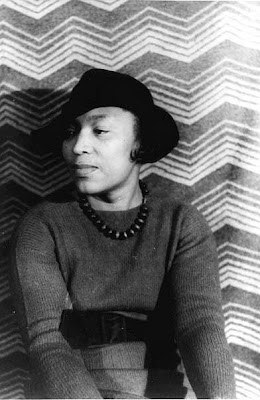 But Hurston wrote other novels, nonfiction books, plays, and newspaper and magazine articles. The first African American to graduate from Barnard College, she was a charter member of the Harlem Renaissance and an ethnographer who documented Southern black folkways on the page and on film -- some of that footage is seen here. She put that culture on stage as well, calling it "the greatest wealth of the continent" and warning, "This stuff won't last long."
She is described here, not necessarily by people who knew her, but people who have spent their lives coming to feel as if they did, as "bodacious," "outrageous," "feisty," "raunchy" and "a rebel." (Photographs show a lively, confident woman of whom this certainly could be true.) "She seems to have been herself all the time," says one commentator. A woman whose early hero was Hercules, Hurston was independent even to a fault, and though she was passionate about her roots, she was not political about her race. "I am not tragically coloured," she wrote. "I do not weep at the world. I am too busy sharpening my oyster knife."
Enthusiastic talking heads include Alice Walker, who placed a headstone on Hurston's unmarked grave -- "A Genius of the South," it read -- and helped revive interest in the author. Maya Angelou sings two styles of blues. There are residents of Eatonville, the all-black Florida town where Hurston grew up, and Dorothy West, who knew Hurston in Harlem. (West died in 1998: Producer Kristy Andersen worked on the film for 18 years.) The seemingly ubiquitous Henry Louis Gates Jr. for once appears as the literary theorist he is: For Gates Their Eyes Were Watching God is "a novel about the capacity of the African American vernacular to narrate a novel, to tell a story."
That use of vernacular, and its apolitical story of a woman's self-discovery, put it out of favour with African American critics of the time -- though it was praised by the white press. Richard Wright, not yet the author of "Native Son," was particularly dismissive, and even Hurston's old mentor, Alain Locke, termed it "pseudo-primitive." (She called Locke a "malicious little snot" in return. "I will send my toenail to debate him on what he knows about Negroes and Negro life.")
As the century wore on, Huston fell out of fashion, and further out of step. A "bootstrap Republican," she found forced desegregation insulting to black culture, which she regarded as self-sufficiently rich and varied. She published her last novel in 1948, wrote more novels she couldn't get published, and died in 1960 with her books out of print. But they are all back now.
It’s possible, though, to draw your own portrait from the film’s wealth of testimony. It’s likely to be that of a woman whose independence, sardonic humour and ability to live in the moment are distinctively modern — on display every day in reality television shows and music videos and book clubs, but so rare as to be threatening in 1930s and ’40s America.
And she combined that attitude with a scholar’s fierce powers of observation, which are evident in this documentary’s best asset: long clips of film of children dancing in Eatonville and of preachers and carpenters at work, shot by Hurston herself during her field research. It’s a combination that can also be seen in the writers and scholars who testify here to her influence. They are her champions and her heirs.
In her speeches and writings — including her autobiography, Dust Tracks on a Road, which is liberally quoted by the film’s narrator, S. Epatha Merkerson — Hurston shaved a decade from her age and substituted the all-black town of Eatonville, Fla., where she grew up, for her actual birthplace in Alabama. The film doesn’t speculate about her reasons, but we can: perhaps when being a black woman in the Jim Crow South means that you finish high school at 27 and don’t become the first black graduate of Barnard College (with a bachelor’s degree in anthropology) until 36, you find it practical to obscure your age.
Zora Neale Hurston proves a feisty subject for PBS' American Masters series, reports Robert Lloyd. Jump at the Sun, written by Kristy Andersen and directed by Sam Pollard, does a fine job outlining Hurston’s life and her near-miraculous achievements, drawing on an unusually impressive and interesting group of talking heads. The roster includes the writers Edwidge Danticat, Maya Angelou and Alice Walker (who spurred the rediscovery of Hurston’s work in the 1970s) and the scholars Tiffany Ruby Patterson, Emily Bernard and Henry Louis Gates Jr.
Lloyd has a kind of collect-them-all affection for the PBS biographical series American Masters, now in its 22nd year and happily catholic in its definition of who qualifies as an American Master. Jasper Johns, Julia Child and James Brown, to name just three whose names start with J. Some editions are better than others, of course, and few are really critical of their subjects, even when allowing a peek at the warts -- their American mastery is expressed and explicated, yet always taken as read. But most all are better than what passes for "biography" on most other networks, where a couple of hit records or a popular sitcom is considered reason enough to haul a star's old elementary school teacher in front of a video camera. (There are a lot of hours of TV to fill.)
It takes a little more than that to become an American Master. This latest episode, airing tonight concerns the author of Their Eyes Were Watching God, which, most famously, Oprah Winfrey and Halle Berry converted into a TV movie a few seasons back.
 But Hurston wrote other novels, nonfiction books, plays, and newspaper and magazine articles. The first African American to graduate from Barnard College, she was a charter member of the Harlem Renaissance and an ethnographer who documented Southern black folkways on the page and on film -- some of that footage is seen here. She put that culture on stage as well, calling it "the greatest wealth of the continent" and warning, "This stuff won't last long."
She is described here, not necessarily by people who knew her, but people who have spent their lives coming to feel as if they did, as "bodacious," "outrageous," "feisty," "raunchy" and "a rebel." (Photographs show a lively, confident woman of whom this certainly could be true.) "She seems to have been herself all the time," says one commentator. A woman whose early hero was Hercules, Hurston was independent even to a fault, and though she was passionate about her roots, she was not political about her race. "I am not tragically coloured," she wrote. "I do not weep at the world. I am too busy sharpening my oyster knife."
Enthusiastic talking heads include Alice Walker, who placed a headstone on Hurston's unmarked grave -- "A Genius of the South," it read -- and helped revive interest in the author. Maya Angelou sings two styles of blues. There are residents of Eatonville, the all-black Florida town where Hurston grew up, and Dorothy West, who knew Hurston in Harlem. (West died in 1998: Producer Kristy Andersen worked on the film for 18 years.) The seemingly ubiquitous Henry Louis Gates Jr. for once appears as the literary theorist he is: For Gates Their Eyes Were Watching God is "a novel about the capacity of the African American vernacular to narrate a novel, to tell a story."
That use of vernacular, and its apolitical story of a woman's self-discovery, put it out of favour with African American critics of the time -- though it was praised by the white press. Richard Wright, not yet the author of "Native Son," was particularly dismissive, and even Hurston's old mentor, Alain Locke, termed it "pseudo-primitive." (She called Locke a "malicious little snot" in return. "I will send my toenail to debate him on what he knows about Negroes and Negro life.")
As the century wore on, Huston fell out of fashion, and further out of step. A "bootstrap Republican," she found forced desegregation insulting to black culture, which she regarded as self-sufficiently rich and varied. She published her last novel in 1948, wrote more novels she couldn't get published, and died in 1960 with her books out of print. But they are all back now.
It’s possible, though, to draw your own portrait from the film’s wealth of testimony. It’s likely to be that of a woman whose independence, sardonic humour and ability to live in the moment are distinctively modern — on display every day in reality television shows and music videos and book clubs, but so rare as to be threatening in 1930s and ’40s America.
And she combined that attitude with a scholar’s fierce powers of observation, which are evident in this documentary’s best asset: long clips of film of children dancing in Eatonville and of preachers and carpenters at work, shot by Hurston herself during her field research. It’s a combination that can also be seen in the writers and scholars who testify here to her influence. They are her champions and her heirs.
Saturday, 5 April 2008
Travels in written Britiain
 As Melvyn Bragg embarks on a literary tour of Britain, he tells Serena Davies why his new series has a ‘grit’ absent from TV’s other celebrations of our island...
Melvyn Bragg’s enthusiasm is contagious. “It’s a fair bet that this is the most written about country on the planet that there’s ever been,” he gushes. The country in question is of course Britain – the inspiration for Shakespeare’s “scepter’d isle”, Blake’s “green and pleasant land” and Burns’s “bonny Doon”. Everyone knows a quote or two about our country, even if they didn’t think they did.
It is these famous sayings coupled with much more obscure writings that will make up the content of Bragg’s new series, Melvyn Bragg’s Travels in Written Britain, starting on Sunday on ITV1. The passages themselves will be read by some of our most popular actors and personalities, Stephen Fry, Jasper Carrott and Tracey Emin among them. Added to these will be the occasional arresting voice from the past – the 1922 recording of TS Eliot intoning The Waste Land’s bleak vision of the London crowds traipsing to work makes a star turn.
Interspersed with these readings will be Bragg’s journeys around different parts of the British Isles. Each of the series’s four episodes will feature a different region: London, the North, the Midlands, and Scotland. These have been selected for the stories, both literary and historical, that they’ve produced. Although the South Bank Show stalwart concedes that there are other areas he could have covered, and is bracing himself for criticism for these omissions.
“One of the things which British critics are absolutely brilliant at, I’ve discovered in my time,” says Bragg, “is that they delight in telling you what you didn’t do… I’m very happy with these programmes. There’s a lot of meat in them. We’ve got Shelley, Wordsworth, Dickens. We’ve got great writers, and people whose words have never even been spoken before.”
By interweaving the texts of literary writers with those of more ordinary records such as newspapers and letters, Bragg will tell some remarkable tales. One involves the lady whose birthday invitation is the only piece of writing in a female hand to survive in Britain from the days of the Roman Empire. We hear, too, of a 12-year-old factory girl who had to carry back-breaking loads of bricks in the days of the Industrial Revolution. Then there’s the 19th century’s Maid of Buttermere, a Cumbrian girl whom one travelling scribe described as the epitome of English country beauty – turning her into a tourist attraction overnight. Her subsequent fortunes were recorded in an article in a local paper – by a jobbing journalist named Samuel Taylor Coleridge.
This last story holds a particular appeal for Bragg (he’s written a book about it) because it is about the area he comes from. In fact, he pinpoints growing up in Cumbria as the inspiration for this series, as well as the reason behind the passion for literature and language as evinced in his previous television series, 12 Books That Changed the World and The Adventure of English.
‘I was brought up two or three miles from the edge of the Lake District but as soon as I could ride a bike or go youth hostelling I was all over it,” he explains. Which means he was “all over” its literary figures, such as William Wordsworth and Thomas de Quincey, too.
“So I was aware I was going through several different sorts of landscapes. I was going through the adolescent landscape growing up, I was going through a real landscape and I was going through a written landscape.”
It is this sense of landscapes real and metaphorical that he wishes to convey in Written Britain. Landscapes “written” not just by poets but also by the folk writer of the famous ballad Do ye ken John Peel, for example, who hailed from Bragg’s hometown of Wigton, and by miners, such as those from his father’s side of his family, who wrote accounts of their labours.
His concern for the grimier realities of Britain’s story means, Bragg says, that his show will stand out from the crowd.
“There’s lots of programmes on nine o’clock on a Sunday night going on about how great Britain is,” he says. He thinks “they’re all wonderful”, and although he declines to specify series, his likely reference points include ITV1’s Britain’s Favourite View, and the BBC’s A Picture of Britain and The Nature of Britain.
“I’ve got nothing but praise [for these programmes],” he goes on. “On the other hand, there’s a bit of grit somewhere: when you’re looking at castles I’d quite like to know who built them. Not who [commissioned] them, but who built them: what stones they used, and how they hauled them.”
Bragg is hoping that ITV finds pockets deep enough to commission a second series of Written Britain. But he’s well aware that the channel that gives him 18 South Bank Shows a year has nothing like the budget for factual programmes that the BBC has. “We’re a lean machine, we’re lean and mean,” he says, speaking of ITV. “The gap between us is now amazing. Good for the BBC. And good for us that we keep doing it.”
Melvyn Bragg’s Travels in Written Britain begins on ITV1 on Sunday, 6 April at 10.45pm
Subscribe to:
Posts (Atom)
