The journalist and documentary-maker Jon Ronson has interviewed some, to say the very least, curious characters. Among his interviewees for his 2001 Channel 4 series Secret Rulers of the World, for example, was the conspiracy theorist David Icke, who informed Ronson that the planet was run by a race of shape-shifting extraterrestrial lizards. But Reverend George Exoo may be Ronson’s most perplexing subject yet.
Exoo, who we’ll meet in Ronson’s unsettling documentary Reverend Death (Channel 4, Monday, 10.00pm) is a Unitarian pastor in West Virginia, USA who helps people to commit suicide. Not people who are terminally ill. People who simply don’t want to go on living. He advises them on ways to go about killing themselves: what pills to use and so on. Often he’s present when they go through with it. He says he’s helped more than a hundred people die. Ronson first heard of Exoo in 2002, when a producer friend alerted him to a news story from Ireland. A woman, Rosemary Toole, had been found dead in her Dublin house, and the police believed it was a case of assisted suicide. Their suspect was Exoo, and they applied to have him extradited from the US to stand trial. In Ireland the sentence for assisted suicide is up to 14 years in prison. In the US the law is foggy: assisted suicide is not a crime in 25 of the 50 states.
Exoo’s activities may sound repugnant. But Ronson says that, when he set out to make the film, he intended it to be supportive of Exoo. ‘I was going through a bit of a libertarian phase,’ he says. ‘The Irish prosecutors seemed very draconian. It looked black-and-white to me: surely everybody has the right to end their life. So my first thought was that it would be nice to do something quite positive.’ You couldn’t exactly say that was how it turned out. Ronson found himself repeatedly changing his views about what Exoo does. Some friends of Ronson’s who have already seen the film say they don’t think Exoo comes across at all well. Having seen it myself, says Michael Deacon, I think Exoo’s a creep. But, at least initially, Ronson liked him: ‘He was funny – he had that camp sort of humour, black humour.’
Well, his humour would have to be black, wouldn’t it? In a bit of film that didn’t get used, Exoo drove for six hours through heavy snow to meet a woman called Molly who’d asked him to help her kill herself. Exoo arrived at her house but nobody appeared to be in. So he drove all the way home again. He later learned she’d already killed herself. The pastor’s response to this news, Ronson says, was to look ‘rueful and amused – he’d gone all that way…’ Exoo, Ronson adds, appears not to see any inconsistency in his own beliefs. Exoo is a man of God, yet he’s helping people die. ‘He’s certainly not ashamed of what he does, he’s proud of it,’ says Ronson. ‘He sees himself as Mother Teresa. Consequently he was never worried about telling us any of this stuff. There was only one moment, in 50-60 hours’ worth of filming, where he said, “I don’t want you to use that bit”.’
Ronson may have liked Exoo on a personal level, but, as the documentary shows, the ethics of what Exoo does are, at the very least, problematic. And Exoo isn’t the only one providing this type of ‘service’. Ronson says there’s a ‘euthanasia underground’, and that ‘it’s a complete mess’. Viewers will see how in the film.
Making Reverend Death – which took around six years, on and off – was the most stressful and emotionally draining job Ronson has done: ‘It’s not been enjoyable, really,’ he says. It’s in sharp contrast to his most recently broadcast work: Journey to the Other Side, a documentary about UFOs he made for Radio 4 with the pop star Robbie Williams. "That was a blessed relief, because that was easy," says Ronson. "Part of me thinks that in the end you should just do things that people enjoy, bringing happiness and laughter to the audience instead of misery. Robbie just approached me and said he was a fan of Them [Ronson’s bestselling book about conspiracy theorists] and said, you know, 'Let’s have paranormal adventures like Mulder and Scully.’"
All the same, Ronson is proud of Reverend Death. "I think the film’s big achievement is learning that this kind of euthanasia underground exists and showing how it operates," he says. "There are some above-board “right to die” campaign groups who will secretly refer people to George. If a mentally ill person phones up and says, 'Will you help me to die?', the group will say no. But if they keep phoning back, as mentally ill people are kind of wont to do, the group will say, 'Well, you might want to phone George Exoo…' It’s extraordinary."
Reverend Death is on Monday on Channel 4 at 10.00pm
Showing posts with label Documentary. Show all posts
Showing posts with label Documentary. Show all posts
Saturday, 17 May 2008
Thursday, 15 May 2008
Channel 4 to show DiCaprio documentary

Channel 4 is to broadcast The 11th Hour, the polemical documentary about the environment fronted by Leonardo DiCaprio. In the documentary, which the channel will transmit on May 25, leading scientists, environmentalists, politicians and activists advance the argument that the Earth is facing environmental disaster, and ask what can be done.
Notable figures featured in The 11th Hour include professor Stephen Hawking, former Soviet leader Mikhail Gorbachev and Nobel Peace Prize winner Wangari Maathai speak about global warming, deforestation, mass species extinction and the depletion of the oceans' habitats. The film also calls for restorative action to change global human activity through technology, social responsibility and conservation.
It lays responsibility for the warming of the planet mostly on the greenhouse gases emitted into the atmosphere and also makes the claim that not since a meteor hit the planet 55m years ago have so many forms of life become extinct. The film, narrated and produced by DiCaprio, was written and directed by Leila Conners Petersen and Nadia Conners. It received critical praise when it premiered at the Canned Film Festival last year, with Times film writer James Christopher describing it as "brilliant and terrifying".
However, it also attracted some criticism, with former Greenpeace member Patrick Moore branding the film as "Hollywood hype" in an article for the Vancouver Sun. Channel 4 has bought the UK broadcast right to the documentary from Hollywood studio Warner Bros. Warner Home Video UK has also scheduled a DVD release of the film for June.

Sunday, 11 May 2008
VH1's pale imitation of the Sexual Revolution
This is compelling television to be sure -- after all, we're talking about sex: hippies cavorting in the altogether. Women's libbers brandishing their bras. Playboy bunnies and Hugh Hefner. Helen Gurley Brown and Burt Reynolds's naked centrefold. Suburban swingers. Jaybird-naked couples shedding what remains of their inhibitions at the infamous Plato's Retreat. Drag queens and porn stars. But there's something missing from this made-in-America tableau: Almost every single one of the characters in the spotlight is white, notes Teresa Witz.
Such is the case with VH1's new, four-part documentary series: Sex: The Revolution, which starts tomorrow night. "Sex" presents a sweeping survey of the seismic changes in 20th-century American sexual mores, and the legal and cultural shifts that resulted from it. A large part of the problem is that it tries to do too much, tossing out historical highlights and lowlights at breathtaking speed. The talking heads who shape the discourse over four hours -- Erica Jong, Armistead Maupin, Hefner and Gloria Steinem -- tend to be the usual suspects, while black and brown folks get shoved to the background. They're the soundtrack through which white folks found sexual salvation. (Cue the Little Richard music. See the stoned sister falling out of her dress at Studio 54.)
"It's true," says Hart Perry, who directed the series along with Richard Lowe. "At one point, we were dealing with the cultural crossover between black and white . . . when we talk about rock-and-roll. I wanted to talk about Norman Mailer, the 'White Negro.' . . . [But] there was too much competition for stories. This is certainly not the definitive story on the sexual revolution."
It is a story of the sexual revolution, shown through "the artifacts of culture," news footage, films, music videos, photographs, with a chorus of white boomers commenting on the action, and reminiscing about times gone by. Melvin Van Peebles, black feminist Michele Wallace, Danny Glover and musician Nile Rodgers make brief appearances; no Latinos or Asians are interviewed. (Glover on San Francisco's "Summer of Love": "It was about taking mescaline and getting laid. Or smoking weed and getting laid.")
Question: How can you talk about the cultural icons of the sexual revolution and not discuss blaxploitation diva Pam Grier? Or extol the significance of a loincloth-clad Jo Raquel Tejada, a.k.a. Raquel Welch, in "One Million Years B.C."? Why is it that instead we are told that the poster girl for the female orgasm was Jane Fonda in "Barbarella"? Or Marilyn Chambers, the Ivory Snow soap model gone bad in "Behind the Green Door"?
In days gone by -- many days gone by -- we as a nation were a buttoned-up lot, having sex but never copping to it, repressed and reactionary. Good girls didn't do it, not unless they'd signed on the dotted line, crossing the great divide between Mrs. and Miss. Good boys never did it with other boys. The bad boys who did were thrown in jail, diagnosed as sick and probed with electrodes in an effort to "cure" them. Throughout much of the country, interracial marriage was illegal, as was birth control -- even for married couples in Connecticut. Fear ruled. You fornicated at your peril. But after Alfred Kinsey, the '60s, the Pill, Stonewall and Roe v. Wade, something changed: Now people were doing it and talking about it.
So where's the full conversation in "Sex: The Revolution"? Perry says he wanted to explore the legacy of lynching victim Emmett Till and the lethal fear of black male sexuality. But largely missing also is the inclusion of African Americans, Latinos, Asians, etc., as participants in the process. Watching the first segment, we see sex anthropologist Kinsey in the late 1940s and early '50s loosening up America with his books, "Sexual Behavior in the Human Male" and "Sexual Behaviour in the Human Female," and we see black-and-white films featuring terrified white kids scared to even kiss. Then the footage cuts to Little Richard jamming with his guitar, and suddenly the (white) kids are rocking and rolling and going nuts. The message: Black sexuality is alien and different from "mainstream" society, contagious and powerful enough to make everyone else abandon all constraints.
When white feminists are talking about being pushed to the sidelines of the antiwar movement by macho males, the segment cries out for a little perspective. Like hearing how Black Power pioneers Kathleen Cleaver and Elaine Brown felt when Stokely Carmichael declared that the only position for a woman in the Student Nonviolent Coordinating Committee was "prone."
It's cool that the filmmakers explore the beginnings of the gay and lesbian pride movement, and how the Stonewall uprising of '69 was the watershed moment in the movement. But it would've been nice if the directors had acknowledged that it was black and Puerto Rican drag queens such as the late Marsha P. Johnson and Sylvia Rivera who got things started back when the cops showed up at the Stonewall Inn.
Sex: The Revolution airs on VH1 at 10 p.m. Monday through Thursday. Uncensored encore showings will be on the Sundance Channel on May 19 and 20 at 12 a.m.
The Duke of Edinburgh - capo di flat capo of the Firm
Is he a national treasure or a doddery old diplodocus? Here's a chance for us to decide about Prince Philip writes Caitlin Moran...
Here's something you never hear people say: the Royal Family are really interesting. Really, really interesting. Popular belief has it that they're a brace of bland, right-wing toffs, who come as either (a) stroppy and ageing, in wellington boots, or (b) stroppy and younger, in nightclubs; and that it does not behove the thinking woman to spend more than six seconds a year thinking about them. And even those six seconds should be spent on saying: “Christ, how I yearn for revolution!” when looking at Prince Andrew and his gigantic, frying-pan-sized face - like JFK, inflated by a bicycle pump - being carted around the golf courses of Andalusia.
But you know what? The Royal Family are fascinating. Fascinating. If we like the kings and queens of the olden days - Elizabeth I, the doomed, permed Charleses, good old completely murderous Henry VIII and his overstuffed tights - then the modern lot are no less diverting. In Dorset, with his former mistress, the Prince of Wales is quietly building an organic toy village, in which he is some omnipotent, Duchy sausage-as- sacrament Godhead. Princesses Beatrice and Eugenie may sometimes socialise with controversial Camdenites - leading to the intriguing possibility that, one day, the Queen might be introduced to Amy Winehouse. And Diana - well Diana, as we all know, was murdered by aliens.
The Royal Family? They're a great bunch. As far as I recall, they cost us a penny a week - less than the TV licence - and they're up there with Holby City in terms of entertainment. And, this week, ITV1 is widely in agreement with this sentiment - broadcasting a blockbusting two hours of documentary celebrating that capo di flat capo of the Mountbatten-Windsors - the Duke of Edinburgh.
At 87, his tenure in the public eye has spanned two very different media ages. At the beginning of his royal celebrity, the press were in the pockets of the Establishment. Prince Philip was, therefore, presented as “dashing” (in royal terms “dashing” means “has more than one eye, can stand up, knows the difference between up and down, won't have to be hidden away in a cellar in Glamis Castle for 60 years in the care of a drunkard maid”). Philip was depicted as “a mystery inside an enigma”.
Of course as the years have gone on, and the tabloid press has lost its reverence for the Royals, Philip has been further revealed to be, broadly speaking, “a mystery inside an enigma inside a git”, but I personally do not feel that dims his appeal. Well, perhaps “appeal” is too fond a word. And I've already used the word “fascination” twice. What I mean, I suppose, is that nearly everything about Prince Philip inspires an amused amazement.
Officially, he is the “first gentleman of the land” - even more senior in rank than Prince Charles, or the Prime Minister - but everything about him is so ... petty, and suburban. He was born in a house called Mon Repos on Corfu - I know! How Casa BevRon - seduced our beautiful future girl-Queen, like Tom Conti in Shirley Valentine, and then spent the next 60 years moaning, bitching, shooting, and making wholly inappropriate comments while on state visits.
“Do you still throw spears at each other?” to a group of Aboriginal businessmen.
In the foreword to a book: “If I'm reincarnated, I'd like to come back as a deadly virus, to counter overpopulation.”
And to the people of the Cayman Islands: “Aren't most of you descended from pirates?”
He is basically Alf Garnett with a wardrobe full of ceremonial swords. The people of Vanuatu Island, in the South Pacific, worship Prince Philip as a god, you know. They pray to pictures of him. Imagine if they ever saw an episode of Top Gear! It would blow their minds! They'd all convert over to the new God, Clarkson, like a shot.
Do not get me wrong. I am no smug contrarian. I do not think the world would be a “better place” if there were more “great characters” like Prince Philip. Broadly speaking, I think he's a total arse.
But if there were a single, doddery old diplodocus left in the world, you'd definitely want to put in some quality time observing its soon-to-be-extinct habits and mannerisms, before it finally keeled over. And for a two-hour chance to do just this, we must thank ITV1. We must thank them profoundly.
The Duke: a Portrait of Prince Philip, Mon & Tues, ITV1, 9pm
It's Hand of God v Iron Mike
The Cannes film festival has always been a magnet for some of the most famous people on the planet. Now it makes way for two of the most infamous sports stars: one is "the baddest man on the planet" who bit a chunk out of a competitor's ear, and the other is so venerated a church was created in his honour. Mike Tyson and Diego Maradona are the subjects of two keenly anticipated documentaries to be shown at the festival. The sporting pair are expected to draw large crowds on the Croisette when they visit over the next two weeks.
Maradona has been filmed up close by one of Europe's most respected directors, and a Cannes favourite, Emir Kusturica. The Bosnian Serb is a double Palme d'Or winner for his 1985 movie When Father Was Away on Business, a child's eye view of post-war communist Yugoslavia, and his 1995 three-hour epic Underground, which traced and satirised Yugoslavia between 1941 and 1992. It has raised eyebrows that such a revered director wants to document Maradona. The simple reason may be that Kusturica adores football. So why not one of the most naturally gifted - and controversial - footballers, filmed by one of the most brilliant directors.
An interview Kusturica has given to publicise the film is unlikely to endear him to England fans, many of whom remember Maradona for only one thing: the "hand of God". He put England out of the 1986 World Cup by punching in Steve Hodge's miscued clearance and then scoring a second goal that ranks among the all-time greats. Maradona became a hate figure in the British media, but his reputation more generally went into freefall when he failed drug tests in 1991 and 1994. With his chronic cocaine habit, drinking and noticeable weight gain he seemed like a man out of control, although he is now said to be out of the woods.
Kusturica is clear whose side he was on in 1986. "I was one of millions of people across the world who jumped for joy while watching those two goals against England in 1986," he said. "That match is perhaps the first and the last time there has been justice in the world."
The justice, he continued, was part of a wider political context with both Argentina and Serbia being victims of "western power" in the form of the International Monetary Fund. "Furthermore, in Serbia Maradona is extremely popular. Our football resembles that of the Argentines. It is also said that I am the Maradona of the cinema."
That the portrait of Maradona will be affectionate seems to be without doubt. Kusturica accuses other film-makers, as well as journalists, of bending the truth when it comes to the footballer. "Film-makers understand nothing about football," he said. "They are incapable of speaking about it."
The Paris-based director said he plans to reveal three Maradonas: the football teacher, the family man and "the politically incorrect citizen against the unilateral politics of the USA". The latter relates to Maradona's anti-Bush statements and the former footballer's friendship with Fidel Castro and Venezuela's president, Hugo Chávez.
"The film will be very complex to make, because I want to show the true personality of Maradona," said Kusturica. "Football is a science of great mathematic precision."
As if to rub it in the faces of England fans, the closing scenes of the film were shot in the Aztec stadium in México City: scene of the hand of God.
A similarly affectionate portrait of the boxer Mike Tyson can be expected from the maverick US auteur James Toback, whose film has been chosen for the Un Certain Regard section of the competition. While there is no question of Tyson being one of the greatest world heavyweight champions, he is also the anti-hero. The man who bit a chunk out of Evander Holyfield's ear in 1997 and who served three years in prison for raping a beauty pageant contestant in 1992.
Toback said he had been always been fascinated by Tyson and cast him in his semi-improvised - and star-studded - 1995 movie Black and White, which satirises rich, white liberal kids who want to be black. The funniest scene has Robert Downey Jnr's sleazy gay character coming on to Tyson: he gets slapped. "I'm from a different culture," says Tyson.
In an interview with Variety magazine, Toback said it would be an honest portrait of the boxer. "The point is not to polish his image or make a cinematic apology, but rather to get a first-hand look at a very complex and epic story."
Toback said he had conducted more than 30 hours of interviews with Tyson. "He was honest about all the things that have highlighted his life, from the bitter divorce, the ear-biting, prison, to his becoming a sex addict. He is self-aware, smart and a totally fractured personality, and he made himself completely vulnerable."
The two films are part of what is a particularly strong year for documentaries. Also showing in Cannes will be Chelsea on the Rocks, Abel Ferrara's documentary tribute to New York's Chelsea Hotel; Marina Zenovich's Roman Polanski: Wanted and Desired; and Terence Davies' film on Liverpool, Of Time and the City.
Saturday, 3 May 2008
Bill Bailey and why he loves his old rock
 Bill Bailey fell in love at a young age – not with a girl, but with Stonehenge. The hirsute comedian, who, in a certain light, could be mistaken for a wizard, reveals that “my bond with the place started when I was just a youngster. I remember at that time there was a big battle at Stonehenge between the police and the hippies. It was quite a dramatic scene. There were lots of beardy, long-haired people hanging out of the back of Transit vans, smoking funny cigarettes and dancing in a silly way. Sadly, it got quite unpleasant. All the hippies were bundled into police vans, and afterwards the authorities said, ‘Right, that’s enough of that. Let’s put up a fence and keep the hippies back’. I wasn’t actually there in person – I was at home diligently doing my geography homework. But I was there in spirit, and I thought, ‘Those hippies are my kind of people’. I’ve felt an affinity with Stonehenge ever since.”
So it was Bailey’s “dream job” when the History Channel asked him to front a documentary on Stonehenge. The first episode of a new series entitled My Favourite Place, it homes in on the monument’s mystique. Nobody knows what this conglomeration of about 60 stones is for – and that’s just the way Bailey likes it, reports James Rampton
The 44-year-old – who made his name as one of the team captains in the enduringly likeable BBC Two pop quiz Never Mind the Buzzcocks and is a rare example of a comedian who is as funny off screen as on it – is delighted that the monument can’t be rationalised. “Even as a child, I had a sense of the anarchy of Stonehenge,” he muses. “It’s a maverick, anti-Establishment monument. It’s become synonymous with alternative lifestyles and been claimed as their own by Druids and pagans. I like the fact that you can’t enclose it. You can put up railings, but Stonehenge is still there for all to see. It’s not cloistered away.
“What are the stones for? Aliens, perhaps, dropped them there and used them as a beacon, a landing platform, or a pod. The Arthurian legend is that giants brought them from Africa to Ireland as healing stones, and then Merlin carried them across the Irish Sea using some special, wizardy telekinetic skill.” Or, Bailey posits with a mischievous twinkle in his eye, Stonehenge “could be one giant musical instrument, a huge windchime. That puts those nasty little bamboo ones into perspective, doesn’t it? My own theory is that it was all one massive stone at one stage, and it’s just been chiselled out by ants.”
Another proposition is that Stonehenge, which is a Unesco World Heritage Site, has significance because it lines up directly with the sunrise at the summer solstice. “Could it be a giant calendar for worshipping the midsummer sun?” asks Bailey. But, the comedian affirms with satisfaction, “one can only speculate so far. What is great is that it will always be a mystery. No one knows what really went on at that site, but Stonehenge is still there. It’s been standing there for 5,000 years – and it endures. I love the fact that after so many millennia, it remains such an enigmatic and charismatic place. I’ve got a feeling Stonehenge will always keep some of its secrets.”
In the film, Bailey digs out some of the remarkable stories surrounding this astonishing feat of prehistoric engineering that has fascinated everyone from Charles Darwin to Spinal Tap. The presenter is tickled, for instance, that in 1913 Sir Cecil Chubb gave Stonehenge as a present to his wife, having purchased it through the estate agents, Knight Frank and Rutley. “I’d love to know what the estate agent’s blurb was,” says Bailey with a smile. “For sale. Henge. Pleasant outlook. Good local travel links. Needs attention. 24 bedrooms. Would suit wizard, hermit or wild man. No chain.”
Making My Favourite Place gave the comedian the opportunity to get up close and personal with the stone circles – something that is now forbidden to the rest of us. “In the past, Stonehenge was so accessible – you could just pitch up and wander around the stones,” Bailey recalls. “But I suppose it was inevitable that one day the British Establishment bureaucracy would say, ‘This isn’t right. We need a guard rail and a gift shop. For any national monument to function properly, you need to be able to buy tea towels and key rings!”
Looking back on the project, there is just one thing Bailey would have done differently. “It was so cold, I wore a hoody. The problem is, on screen I look like an unsavoury character let loose at the monument. I appear to be the sort of person David Cameron wants to hug. It was an ill-advised fashion choice. Next time I’ll wear a three-piece suit.”
Bailey concludes that, despite the hoody, “the best thing about making this documentary was the chance to walk around Stonehenge when no one else was there. We had to get there before the official opening. It was six in the morning and it was wet and freezing, but it was so worth it. Nothing beats the feeling of having the place to yourself.”
My Favourite Place, The History Channel, 8pm/11pm, Thur May 8
Child over time
Over the past eight years, BBC1 has been conducting a unique experiment. In Child of Our Time the channel has followed 25 children from their births, and subjected them to rigorous examination. As science broadcaster and academic Professor Lord Robert Winston puts it, ‘Nobody’s done anything like this before.’
Now, with all the participants aged around eight, differences between the sexes are becoming much more apparent. The opener to the latest series looks at the influence of sex and society on the children, and the experiments that its presenter Lord Winston and his team perform reveal the remarkable extent to which boys and girls differ even at a very young age. ‘Eight is a really good stage to look at this,' Lord Winston tells Matt Warman. ‘It’s when children have a clear idea of the differences between boys and girls and have very different aspirations. We weren’t sure how well that would be delineated – but it turned out to be very well delineated indeed. I think what we are showing with a small number of kids represents a generality within children of that age.’
The tests range from studying the difference gender-targeted packaging makes to a child’s choice of soft drinks (boys are drawn to rockets, girls like pink princesses), to setting up a mock ‘shop’ in which the children dress up just as they please (ie without any parental input). The boys’ fashions (hoodies, baggy jeans) contrast sharply with the girls’ (pretty dresses, fishnet tights).
Lord Winston believes children’s gender attitudes are swayed by contemporary trends. ‘I would be hesitant to say attitudes to gender have become different over the years,’ he says. ‘But the influences have become different.’ Thus Child of Our Time cites the modern cults of waif-like models when it shows that modern boys are generally indifferent to body shape while even young girls yearn to be thin. ‘What we’re saying is that this is something we see now, and something we may need to address in our children,’ says Lord Winston. ‘Presumably their rather narrow prejudices have been sorted out by the culture in which we live. But we’re not trying to make judgements; we’re trying to observe. I think that’s the value of the programme.’
This policy of dispassionate, informed observation has allowed the series to show a remarkable development arc in the period it has covered so far. But it can also make some of the participants’ more emotional statements even more arresting because of the scientific context. When one child’s father is shown to be worryingly absent for long periods, the girl’s tears carry all the more significance because the programme has already stressed the importance of a stable home. Her mother’s suggestion that she’d be disappointed if her daughter married a man like her husband also carries troubling undertones. ‘Relationships change between parents all the time,’ says Lord Winston, ‘and obviously we knew that that would be the case when we started making the programme. After all, nearly 50 per cent of marriages break up, but we try very hard simply to be a lens. And on the whole the children that we’re seeing cope pretty well.’
It’s not, however, the children’s resilience that surprises Lord Winston most. ‘The most remarkable thing on a series like this is that all the children and all the families have stuck with it,’ he says. ‘Now we’re quite attached to each other, and I think they enjoy what we do with them – but things might be more difficult when the children reach puberty.’ Those fruitful relationships between the families and the programme-makers are formed through an unusual mix of scientific and social analysis, and Lord Winston is fiercely proud of being part of an accessible programme about science that is shown in primetime on a major channel. ‘Generally, however, I’m very disappointed with the level of science on television,’ he says. ‘The BBC has not in this respect totally filled its public service remit.’
Although he maintains that there are plenty of fine presenters, and that what science there is on television is largely well-handled, Lord Winston reserves his sternest words for BBC1. ‘The channel has tended to go for easy options like light entertainment and has forgotten that science programmes consistently had extremely high ratings,’ he says. ‘When I made The Human Body [a six-part series shown in 1998] it was watched by millions of people. It’s still cited as something that got a lot of people into science at university. Child of Our Time is now the exception – it’s on BBC1, but still brings in a lot of science. The series’s existence shows that it’s perfectly possible to be both populist and scientifically accurate.’
Child of Our Time is on BBC1 on Wednesday, 7 May at 8.00pm
Friday, 2 May 2008
How Morgan Spurlock went from burgers to Bin Laden
 Morgan Spurlock made his name by gorging himself. He tells James Mottram why he's now looking for al-Qa'ida's leader...
With a title such as Where in the World is Osama bin Laden?, you could be forgiven for expecting a hard-hitting documentary. With the premise that a man goes it alone in the Middle East to find the world's most wanted terrorist, it conjures images of a painstaking investigative report, the sort that Donal MacIntyre might take on. Until, that is, you see the poster. The moustachioed Morgan Spurlock, the man behind the McDonald's-baiting Super Size Me, is sitting atop a camel, holding on for dear life as the beast races towards us. If you didn't know better, you'd think it was a new Carry On film.
It doesn't stop there. The film's opening sequences see Spurlock, 37, get in shape for his trip. He does what every sensible traveller does – be it learning those all-important Arabic phrases or undergoing anti-terrorism training and learning kidnap-evasion tactics. After all, there's a $25m reward at stake. Meanwhile, smart computer graphics show Morgan and Osama battling like it was an al-Qa'ida version of Street Fighter. "I love video games," Spurlock later tells me. He has just bought God of War for his new PSP.
Holed up in the office of his New York-based production company Warrior Poets, Spurlock makes no apologies for this comic approach to what is ostensibly a gravely serious subject. "I think we could've made a real investigative journalistic film, which says, 'Where is he? Why haven't we found him? What are the pieces that have gone into the puzzle? What's happened on the ground in these countries? What are they doing to find him?' But, for me, especially coming off of Super Size Me, using humour is a better way to get an audience interested in topics, especially something that's really heavy."
Needless to say, Spurlock does not capture Bin Laden. Estimating that he came within 50 miles of him, in the finale he heads home rather than enter Peshawar, the region of Pakistan many believe currently houses the mastermind behind September 11. I was rather disappointed by this. This is, don't forget, the man who spent 30 days eating three McDonald's meals a day. In his subsequent spin-off television show, 30 Days, he went a month living in prison, and in the forthcoming new series he goes coal-mining in his native West Virginia. This is Spurlock all over: man of the people.
If his methods suggest showmanship, you can't doubt the results. The burger behemoth retired the "super size" fries and beverage options from their menus, replacing them with healthier foods – a move McDonald's denied was a reaction to the film. Nevertheless, Spurlock – who was nominated for an Oscar for his stomach-bloating efforts – evidently got under their sesame-seed baps. "In the UK, they took out full-page ads in The Independent the day the movie premiered at the Edinburgh Film Festival," he recalls. "They spent more on newspaper ads trying to counter the movie the day it opened than I spent on the whole film."
For the latest film, says Spurlock, he really did start out to succeed where the US military and its allies had failed. "You know the deck is incredibly stacked against you, but anybody who buys a lottery ticket doesn't think, 'I'm not going to win'. Even though it's a billion to one, you think, 'maybe I'll be that one'. So we thought, 'Why not?' But, as we went around the world, we realised it was about so many other things. For me, that's what great about the movie – how things unfold over the course of this journey."
It's hard to take Spurlock seriously on this point. While this travelogue takes him from Egypt through Morocco, Israel and Saudi Arabia, and later the more dangerous areas of Afghanistan and Pakistan, there's no doubt that setting out to find Bin Laden is as much of a gimmick as eating a bellyful of Big Macs. Is it not possible that many could think he's being glib about the subject? "I think that when you go in with good intentions, good things come out of it," he replies. "While some reviewers have said that, that's not been the overwhelming response from the audiences. And that's who ultimately I want to go see the film – the regular people."
He cites various attendees at recent US screenings, and tells me that they've thanked him for breaking down Middle Eastern politics into easily digestible chunks. "That's what it's about – trying to make things accessible to everyone," he says. "There's a big giant gorilla in the corner we don't understand when it comes to global politics. But what the film does in a real easy way is to break things down in very simple terms of what's happening in each of these countries. It paints a picture of what people face in their daily lives."
Certainly Spurlock's ability to communicate to the common man is beyond question. Yet the popularity of his work – not unlike that of Michael Moore – says as much about the intelligence of his fans than it does about his skills as a documentary film-maker. Spurlock argues that he's trying to combat the US media-fuelled negative stereotypes that all those in the Middle East are fanatics. "We get fed one dominant version of what exists overseas – somebody who is burning a flag, or burning an effigy of Tony Blair or George Bush, or they're screaming about how they want death to the West and America, and that's the sum of the whole. What the film does a great job of doing is putting a face on this overwhelming majority out there, which is not those people, and giving them a voice. I don't get to see these people that are in this movie on television here. I don't even read about them in newspapers most of the time."
If this point has some validity, what grates about Spurlock's film is its inherent sentimentality. Two months into pre-production, he discovered that his wife, the vegan chef Alexandra Jamieson, was going to give birth. Thus, in what could arguably be seen as another gimmick, it becomes a race against time for Spurlock to find Bin Laden before he must return to his Brooklyn home for the momentous day when his son, Laken – now 16 months old – comes into the world. Spurlock argues that his quest changed dramatically when he discovered that he was going to be a father. "That was the moment when the film really was born – no pun intended. It shifted away from being, 'where is Osama and why haven't we found him?' to, 'what kind of world am I about to bring a kid into?"
To be fair, there's no doubt that Spurlock's mission is laced with danger. As the film unfolds, and Spurlock moves closer to where Bin Laden might be, there is a very real sense that he's playing with his own life. "It was frightening," he admits. "As you start getting closer and closer, your heart starts beating further and further up in your neck!" Though he ultimately visits Tora Bora, the cave-riddled region where Bin Laden once lived, "the scariest moment" is the scene where he is embedded with US troops in Afghanistan. "These guys are targets every day," he says.
At one point, Spurlock is pulled away by his army guides as the nearby village falls under attack from the Taliban and a man is killed in the ensuing scuffle. "The Afghan national army ultimately killed that guy – a guy called Throatcutter," says Spurlock. "He got the name Throatcutter for slitting his brother's throat to gain advancement in the Taliban." While Spurlock's bravery is evident, his naivety – notably when he asks permission to shoot a rocket into the mountains, which he describes as "awesome" – is as apparent.
The best moments come when Spurlock is interacting with different cultures. One scene, set in a mall, sees him approaching women in burkas, asking them to speak to him. When he does manage to quiz two students in a school about their thoughts on America, their answers feel disturbingly stage-managed. Just as telling are the conditions this informal chat is held under. Closely monitored by the pupils' teachers, Spurlock sees the interview shut down when his questions get too contentious. The film becomes an exploration of the feelings held by everyday Middle Eastern people-on-the-street towards America. As one Egyptian says, "We've grown to expect a lot less from the United States."
"There was a time when the United States was really put up on a pedestal as this beacon of hope and democracy and that's gone now," says Spurlock. "The United States is now seen as an aggressor, a country that wants to dominate others, that wants to use all of the natural resources of other countries, to eradicate the religion of Islam. But that's really not the vision of the States that should be out in the world, in my opinion."
Wednesday, 30 April 2008
McCanns tell of regrets in TV documentary
Kate and Gerry McCann considered taking their children out to dinner with them on the night their daughter Madeleine went missing instead of leaving them alone in their Portuguese holiday apartment while they ate tapas nearby, they reveal in a documentary marking the anniversary of her disappearance. In the two-hour programme, the couple say they talked about going to another restaurant, the Millennium, with the three-year-old and her brother and sister, but decided not to because it was a half-mile walk and they did not have a buggy.
Kate McCann also tells how she has "persecuted" herself for not questioning Madeleine more when the girl mentioned that morning that she had cried the night before in her parents' absence at the Mark Warner resort in Praia da Luz. Madeleine, One Year On: Campaign For Change, which is on ITV1 at 8pm tonight, shows the McCanns at home in Rothley, Leicestershire, with twins Sean and Amelie, and follows them to Brussels and Washington as they campaign for an EU-wide alert system for missing children.
In extensive interviews Kate McCann's eyes frequently fill with tears as she recounts how she discovered Madeleine was not in her bed and imagines how she might look now, aged nearly five. Gerry McCann describes their feelings on being made arguidos, or official suspects, in the case by Portuguese police as like being "in the middle of a horror movie" and speaks of still not knowing where Madeleine is as "purgatory".
Kate also hints openly for the first time at a deal reportedly offered to her by police if she admitted accidentally killing her daughter and staging an abduction, telling the programme she was not going to be "railroaded". She later attacks the Portuguese police and accuses them of deliberately leaking details of the investigation to smear the couple. The couple are banned by Portuguese law from speaking openly about what happened inside the police station, but Kate McCann appears to address the issue of the reported deal, saying: "No, I'd have fought to the death, to be honest, at that point. There was no way I was going to be railroaded into something."
The programme's makers insist the couple had no editorial control. They were not paid, but a £10,000 donation was made to the Find Madeleine fund. Much of the documentary is shot in the family home, where they are seen returning to everyday life: playing with the twins, preparing meals and hanging up washing. In one scene the couple are shown opening piles of letters, which are divided into labelled boxes. One reads "nutty", another "nasty". There is also a section for "well-wishers" and a receptacle for "psychics, visions, dreams".
Kate McCann estimates that 1% of their post is hate mail, as her husband reads out a Christmas card accusing the couple of being "thieving bastards". "Your brat is dead because of your drunken arrogance," says the writer. "Shame on you. I curse you and your family to suffer forever. Cursed Christmas ... You are scum." "That's quite nice," Gerry McCann remarks. "Very charming."
Speaking about May 3 last year, the night Madeleine went missing, he says: "The worst thing is we kind of almost thought about not going." His wife adds: "In fact we were all going to go up to the Millennium again that was with the kids, which is what we did the first night. It was just because the walk was so long and we didn't have a buggy and the kids were tired by that time." Another problem was that the restaurant did not open until half an hour before the children's 7pm bedtime. With no buggy, they were forced to carry the children home between the two of them on their previous visit.
The McCanns and the seven friends they were on holiday with say they had a system of half-hourly checks on their sleeping children while they dined at the tapas restaurant in the resort each night. "I think if there'd been one second where someone had said 'Do you think it's going to be OK?' it wouldn't have happened," Kate McCann tells the cameras. Her husband adds: "We have to live with the fact that we weren't directly there and if we were, then, you know, possibly, probably, it wouldn't have happened."
They believe a Europe-wide alert system, modelled on the US Amber Alert, which allows television broadcasts to be interrupted and notices to be flashed on motorway screens after a child is reported missing, might have found Madeleine. They need at least 393 MEPs to support their proposal, at which point the European Commission would consider it.
Monday, 21 April 2008
20/20 prepares JK Rowling documentary
While J.K. Rowling is fighting for the integrity of her Harry Potter series in a New York court, ABC is scheming to make a documentary about the Potter author's very private life. Reuters reports that 20/20 will air the profile some time in November and will include several interviews, scenes from the final Harry Potter book tour, and a peek at the locations that inspired her characters.
ABC is again working with U.K. producer RDF Media, which raised a royal ruckus last year when its trailer for A Year with the Queen appeared to show the Queen storming out of a photo shoot. In fact, she was walking into the shoot, and RDF apologized profusely for the editing snafu.
The U.S. version of the show, dubbed The Royal Family and anchored by Barbara Walters, averaged 14.1 million total viewers in March, making it the most-watched episode of "20/20" since a 2003 report on Michael Jackson.
Saturday, 19 April 2008
The dangerous methods of Leo Regan
A young NHS hospital doctor called “Ruth” is suspended because she is suffering from depression. She does not tell her employers that she is also hearing a voice in her head, telling her to kill herself. To do so would mean dismissal and probably get her sectioned. She turns to Rufus May, an unorthodox NHS psychiatrist who rejects the use of medication. He believes such voices are full of meaning and that patients should engage with them. He talks to the voices himself. He talks to Ruth’s.
Without medication Ruth becomes temporarily deluded. She is working in a care home for the elderly and thinks that the fish tank in the sitting room is a heart monitor hooked up to one of the residents. Many people would feel terrified of having this otherwise charming young woman treating them in hospital. May wants to get her back on the wards.
This is the disturbing, but challengingly real story of The Doctor Who Hears Voices, the latest film by Leo Regan. His previous subjects have included drug addicts, racists and, more recently, in Scars, an explosively violent criminal. Regan likes to reach the corners of humanity that normal documentary film-makers don’t.
He spends months getting to know his subjects, winning their confidence, coaxing them to open up. If his subjects refuse to be identified, he uses the transcriptions of their conversations as scripts and reconstructs their interviews, talking to professional actors. Jason Isaacs gave a chilling performance as the thug in Scars. In this film Ruth Wilson is equally convincing as the troubled subject.
But, as Regan explains when we meet in a vegetarian café in North London, this film has been far more complex than Scars. Intrigued by reports of a pressure group called Mad Pride, he had gone to Channel 4 proposing to do a film exploring the stigma of mental illness. The organisation led him to May and the initial plan was simply to follow him in his work. “The sections of the film where it’s just me talking to Rufus are straight documentary,” he says. “I spent 18 months with him and saw him working with 48 people. We documented some stories that we thought it wasn’t right to show.” Ruth’s story stood out because it encapsulates the moral dilemmas for doctor and patient alike in an extreme form, but, for obvious reasons, she would only cooperate on condition that she could not be identified.
Regan spent a lot of time talking to the real Ruth on her own. “Rufus wasn’t always comfortable with that,” he says. “He was afraid I might be provoking her in a way that could make things worse.” These conversations are re-enacted by Regan and Wilson using his transcripts. The strangely multilayered reality of the film is complicated even further when Wilson playing Ruth, tells Regan (playing himself) that the voice in her head doesn’t like either May or himself and often mocks them in a way she finds very funny.
A third form of drama-doc hybrid comes when Regan reconstructs encounters between May and Ruth at which he was not present. This time there are no transcriptions, and May and Wilson must improvise using May’s notes of the meetings and what the real Ruth has told Regan she recalls of them. It is, Regan says, his most ambitious project yet.
A Londoner currently based at a hospital in Bradford, May is a former mental patient himself, though he hates such negative terminology. When he was 18 he had paranoid delusions, Regan tells me. “He was found walking naked in the street, and he thought the KGB had implanted a gadget in his chest.” Now free of his illness and happily married with two children, May hates the diagnosis of schizophrenia and the stigma it brought.
But he also knows his methods are controversial and that some of his colleagues regard them as irresponsible if not downright dangerous. “Agreeing to do the film was a huge risk for him,” says Regan. “He had to agree that the film would continue wherever it took us.” At one point, in fact, it seems his treatment may have provoked a dangerous crisis in Ruth. “I rushed up to Bradford overnight to talk to him when he was feeling at his most vulnerable,” says Regan. “I wanted to film him in that moment.”
Regan is shocked by the idea that the film might be seen as too favourable to May. “I pushed him hard all the time,” he says, “challenging what he was doing. I hope that comes across. I had no idea myself how things were going to work out for Ruth.” Further balance is provided by interviews with Trevor Turner, an expert on schizophrenia who is convinced of the efficacy of medication, intrigued by May’s methods but also extremely wary of them.
Underlying the whole film is the moral issue of whether psychiatric patients should lie about their conditions. May himself had to do this and tells Ruth to do so when she goes for her appraisal. In this respect Turner is a surprising ally, agreeing that the stigma of diagnosis is so great that he would omit it from an application form if he were applying for a job.
Inevitably, this film raises far more questions than it can possibly answer. But it shines a powerful light on a condition that, for the sufferers and their families, can be, literally, a matter of life and death.
The Doctor Who Hears Voices, Mon 21 April 2008, Channel 4, 10pm
Tuesday, 15 April 2008
Documentary investigates the rule of 'King Corn'
King Corn (10 p.m. Tuesday, WTTW-Ch. 11) uses a shambling, shaggy style to answer a serious question: Why is our food system so out of whack?
The substance of this documentary will be familiar to readers of Michael Pollan’s 2006 book, The Omnivore’s Dilemma, which examined how industrial agriculture has transformed not just the lives of farmers and animals, but the basic building blocks of our diet. Corn has indeed conquered the American diet, but the mountains of corn that farmers produce (which are subsidized by the government) are a mixed blessing. Food is cheaper, but we are fatter, and when it comes to animals, according to this non-shrill film, 70 percent of the antibiotics consumed in America are fed to cattle.
Yet filmmakers Ian Cheney and Curt Ellis are seen eating juicy burgers in the film. They don’t disdain our fast-food culture — they just want to understand what’s behind it, and they do a good job of explaining that in this hour-long documentary. King Corn may be a little slack and self-conscious in places, but it’s also fair, thorough and quite literally down to earth.
In essence, Cheney and Ellis set out to do what Pollan did: tell the story of how our diet has changed since the ’70s by meeting the people who grow our food. They talked to farmers and cattle ranchers in Iowa and Colorado, and the duo also interviewed cogent and concise food experts, including Pollan. But the King Corn duo went the extra mile, or the extra acre — they went to Iowa to farm corn.
In college, they discovered that they both had relatives who came from the tiny town of Greene, Iowa. After college, they spent almost a year there, where they leased one acre from a local farmer and grew corn. They follow the progress of their crop closely (and when they get their subsidy checks, they regret not planting more corn). But the filmmakers also use homemade charts and lighthearted animated sequences to talk about how government policies altered farming in the ’70s, and how corn harvests have shot up and prices have fallen since then. In their tiny kitchen, they even attempt to make high-fructose corn syrup, the sweetener that has become ubiquitous.
King Corn isn’t just a cogent, low-key examination of where our food comes from and how that has changed in the past 30 years. The film is, in part, a tribute to life in towns such as Greene. Cheney and Ellis note that the cost of food has dropped sharply since their relatives lived there, but they also appear to mourn the passing of a rural way of life that has been disappearing with the advent of ever-larger farms.
Farming itself doesn’t turn out to be a transformative experience – as they note in the narration, “Planting 31,000 seeds was not exactly a hands-on experience. Then again, [thanks to machinery] it took only 18 minutes.”
But a website for King Corn shows that the filmmakers were deeply affected by their experiences. According to the Independent Lens site for the film, the director of the documentary, Aaron Woolf, now runs a “know-where-your-food-comes-from” grocery store in Brooklyn.
Saturday, 12 April 2008
Me and Mr Jones
There are no Indiana Jones thrills in Channel 4's The Quest for the Lost Ark. Professor Tudor Parfitt's over-long documentary is more Time Team than epic archaeology Indiana Jones-style, laments Caitlin Moran...
Let me make one thing very clear: I am no Time Team basher. I love Time Team. I've spent more time looking at the geo-phys on a ruined Tudor piggery than I have the sonograms of my own unborn children. There's no piece of crud-encrusted Roman pottery hoiked from a dead dog pit outside Slough that I haven't got weak historical stims from. Every sub-Horace Goes Skiing graphical recreation of what some medieval drainage ditch “would have looked like, in its own time” is of innate interest to me. I love that stuff.
But let's face it - however interesting Time Team is, it hasn't done the overall image of 21st-century archaeology much good. Not like the 1980s, when archaeology was all about Indiana Jones razzing around looking unbearably hot and desirable. Christ he was hot. Believe me, there isn't a woman alive who doesn't go a bit funny thinking about Indiana Jones. Even Margaret Thatcher would have fancied him a bit.
Because of Indy, for my generation, being an archaeologist was up there with being an astronaut, a rock star or a whale-trainer as one of the all-time glam jobs. But then, alas, Time Team came along. In an epic rebrand, archaeology suddenly went from a) thrusting, sweaty, man-totty saving the world, to b) Womble-like academics in home-knits, sitting in craters, in Monmouthshire, in the pissing rain, wiping oomska off a brown tile with a hankie. Watched by Baldrick.
Given all this, then, what we need - what we all sorely need - is for archaeology to start thinking big again. Go widescreen again. Give up on the getting excited about finding a patch of scorched clay that indicates the possible existence of a Georgian kiln, and start going after the big stuff. The Colossus of Rhodes! The Round Table! Jesus!
And, just in time, here's The Quest for the Lost Ark, which is literally a quest for the Ark of the Covenant. You know - the Nazi melty box thing from Raiders of the Lost Ark. Presented by Professor Tudor Parfitt - a man whose name suggests he might be the long lost Poshest Man in the World; until you see the documentary is produced by one Sheldon Lazarus - The Quest for the Lost Ark attempts to follow a 2,500-year-old trail of clues, and discover the last resting place of the Ark.
I don't think I'm going to wholly disintegrate your day when I tell you that Parfitt doesn't actually find the Ark. Let's face it - if humanity ever finds what is essentially God's handbag, it's not going to be left to the TV critics to break the news. CNN, I think, might get there first.
What Parfitt does do, however, is trace - using DNA - the lost tribes of Israel, their flight into Africa, and the establishment of Jewish tribes in Zimbabwe that exist until this day. It's all quite reasonable and mildly diverting. Definitely worth, say, half an hour of your life; particularly if you're into African Jews.
However, having worked himself up into a big tizzy about his life-long quest for the Ark - “Five years went by without any leads,” he says, at one point, with almost incalculable weariness - and having been giving a whopping and, frankly, unnecessary 75 minutes to fill, Parfitt keeps on flogging the dead Ark horse to a point of mild dementia.
In the end, he becomes convinced that he's found the real Ark. The real Ark, according to Parfitt and not really anyone else at all, is not a sacred box, 80cm wide and high, lined inside and out with gold, topped with a golden lid, and two golden cherubs with outstretched wings, through which one can hear the voice of God.
It's actually - a drum. Yes, a drum. A knackered old drum from Africa. That's, erm, only 600 years old. That Parfitt eventually finds in a cupboard. In a museum. By looking through a card index.
Yes, I know. It's not quite grabbing-your-hat-from-underneath-the-closing-stone-door-having-just-outrun-the-giant-boulder.
So, mmmmm. Whilst it's great to see bone-botherers going for the big ticket historical items again - why settle for a submerged Neolithic toilet-area, when you could track down the intercom to God? - in this case, it doesn't really work, thrill-wise.
To be honest, you would actually get marginally larger cheapies watching Phil Harding eating a fried egg sandwich, in the rain.
The Quest for the Lost Ark, Mon, Channel 4, 9pm
Wednesday, 9 April 2008
Oscar winner and the Eliot scandal
The Eliot Spitzer hooker scandal is getting the documentary treatment. And from an Oscar winner, no less. Filmmaker Alex Gibney, who won a 2007 Academy Award for Taxi to the Dark Side, is talking to distributors and financiers about his planned documentary on Spitzer, the ex-New York governor forced to resign in disgrace after being identified as a patron ("Client #9") of a prostitution ring under investigation by the feds.
Gibney, who's in France at the mipdoc festival - an industry showcase for documentaries - is shopping what's described as a "feature-length" documentary about "a recent, high-profile sex scandal." According to c21media.net, which broke the story, the "high-profile sex scandal" is believed to be the Spitzer saga. It's unknown, at this point, who Gibney has corralled for the documentary, or what, if any, cooperation he'll get from the primary players in the sordid tale.
Gibney's production company, Jigsaw Productions, is based in Manhattan. He received an Oscar nomination for his 2005 documentary, Enron: The Smartest Guys in the Room and he's also done docs on Henry Kissinger and Jimi Hendrix. Taxi to the Dark Side told the story of a cab driver in Afghanistan, and his controversial death at the hands of US soldiers while being held in detention.
Gibney has so far declined to comment.
Tuesday, 8 April 2008
Breaking the silence in the Congo

Harrowing and heart-rending and maddening and confounding, Lisa F. Jackson's documentary The Greatest Silence: Rape in the Congo looks at the sexual violence done to the women of the eastern provinces of the Democratic Republic of Congo over the course of the last decade -- the period, more or less, of the Second Congo War, which, notwithstanding peace treaties in 2003 and January of this year, seems to be rumbling on.
Jackson, whose film won a Special Jury Prize at Sundance and airs tonight on HBO, was herself the victim of a gang rape in Washington, D.C., at age 25, and there is a sense of mission here; it's personal, though not in any way that makes it all about her. Unfunded, she travelled to the DRC, formerly known as Zaire, on frequent-flier miles and into the bush with U.N. peacekeepers (whose hold on the peace is tenuous) to meet the victims of this ongoing monstrosity -- as many as 200,000 women and girls raped (and more) in a conflict generally regarded as the bloodiest since World War II.
Jackson told them of her own rape, "hoping that if I told a woman my story she would break the silence surrounding hers." ("They asked about the war that was happening in my country.") She also talked to rapists -- Congolese soldiers, as it happens, who are ostensibly there to protect the women they've attacked from the foreign militias responsible for the worst atrocities of this multi-party war but who believe that rape is a mystical component to their success on the battlefield. (And there is also male talk of "needs.")
A country the size of Western Europe, the DRC is rich in gold, silver, diamonds, oil, uranium and, not least, coltan, a mineral used in the manufacture of cellphones and laptop computers. The war has provided cover for Rwandan, Ugandan and Burundi militias to steal coltan -- perhaps a million dollars' worth a day; indeed, it's suggested that it's the reason for the war. There is ample room, physically and psychologically, for the unaffected to ignore the afflicted, and Congolese society has traditionally made second-class citizens of women. Government is slow, even loath, to act; perpetrators who are caught easily bribe their way out of custody.
It is a difficult thing to watch, but there's no arguing with it. The documentary brings you close to its subject, and though its main point is unwavering -- women are being brutalized in the most unspeakable ways in eastern Congo -- its effect is increasingly complex. Jackson does a good job of capturing the paradoxical beauty of the setting, and she has structured her film so that even as it grows more horrible, hope glimmers.
We meet Major Honorine Munyole, "eastern Congo's one-woman Special Victims Unit" ("I myself am the sex-crimes police, and I'm also the child protection police"); Dr. Denis Mukwege of the Panzi Hospital, who does what he can to repair broken bodies; and Jackson's gentle U.N. liaison Bernard Kalume, at home with a loving family, perilously close to the Rwandan border. They are beating against a great tide, but they press on.
It's difficult to know what a film like this can accomplish, though it's necessary that such films be made. In 1960, Edward R. Murrow closed the TV documentary Harvest of Shame, about the ill treatment of American migrant workers, saying, "The people you have seen have the strength to harvest your fruit and vegetables. They do not have the strength to influence legislation. Maybe we do." One woman seen in The Greatest Silence hopes that with Jackson's film, "our complaints will be heard at a higher level . . . and we will get some help."
Good night, and good luck.
Further reading: Congo's horror, as seen through a personal lens
Zora Neale Hurston jumps at the Sun
It wasn’t enough, apparently, for Zora Neale Hurston to write a great American novel and to blaze trails for black women as a scholar and an artist. In Zora Neale Hurston: Jump at the Sun, an “American Masters” documentary on Wednesday night on PBS, we learn that she also pioneered a very 21st-century genre: the unreliable memoir.
In her speeches and writings — including her autobiography, Dust Tracks on a Road, which is liberally quoted by the film’s narrator, S. Epatha Merkerson — Hurston shaved a decade from her age and substituted the all-black town of Eatonville, Fla., where she grew up, for her actual birthplace in Alabama. The film doesn’t speculate about her reasons, but we can: perhaps when being a black woman in the Jim Crow South means that you finish high school at 27 and don’t become the first black graduate of Barnard College (with a bachelor’s degree in anthropology) until 36, you find it practical to obscure your age.
Zora Neale Hurston proves a feisty subject for PBS' American Masters series, reports Robert Lloyd. Jump at the Sun, written by Kristy Andersen and directed by Sam Pollard, does a fine job outlining Hurston’s life and her near-miraculous achievements, drawing on an unusually impressive and interesting group of talking heads. The roster includes the writers Edwidge Danticat, Maya Angelou and Alice Walker (who spurred the rediscovery of Hurston’s work in the 1970s) and the scholars Tiffany Ruby Patterson, Emily Bernard and Henry Louis Gates Jr.
Lloyd has a kind of collect-them-all affection for the PBS biographical series American Masters, now in its 22nd year and happily catholic in its definition of who qualifies as an American Master. Jasper Johns, Julia Child and James Brown, to name just three whose names start with J. Some editions are better than others, of course, and few are really critical of their subjects, even when allowing a peek at the warts -- their American mastery is expressed and explicated, yet always taken as read. But most all are better than what passes for "biography" on most other networks, where a couple of hit records or a popular sitcom is considered reason enough to haul a star's old elementary school teacher in front of a video camera. (There are a lot of hours of TV to fill.)
It takes a little more than that to become an American Master. This latest episode, airing tonight concerns the author of Their Eyes Were Watching God, which, most famously, Oprah Winfrey and Halle Berry converted into a TV movie a few seasons back.
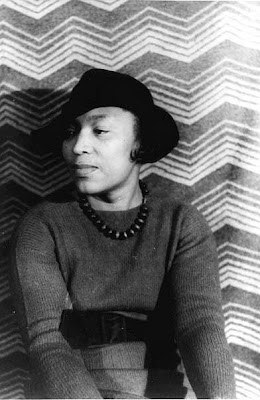 But Hurston wrote other novels, nonfiction books, plays, and newspaper and magazine articles. The first African American to graduate from Barnard College, she was a charter member of the Harlem Renaissance and an ethnographer who documented Southern black folkways on the page and on film -- some of that footage is seen here. She put that culture on stage as well, calling it "the greatest wealth of the continent" and warning, "This stuff won't last long."
She is described here, not necessarily by people who knew her, but people who have spent their lives coming to feel as if they did, as "bodacious," "outrageous," "feisty," "raunchy" and "a rebel." (Photographs show a lively, confident woman of whom this certainly could be true.) "She seems to have been herself all the time," says one commentator. A woman whose early hero was Hercules, Hurston was independent even to a fault, and though she was passionate about her roots, she was not political about her race. "I am not tragically coloured," she wrote. "I do not weep at the world. I am too busy sharpening my oyster knife."
Enthusiastic talking heads include Alice Walker, who placed a headstone on Hurston's unmarked grave -- "A Genius of the South," it read -- and helped revive interest in the author. Maya Angelou sings two styles of blues. There are residents of Eatonville, the all-black Florida town where Hurston grew up, and Dorothy West, who knew Hurston in Harlem. (West died in 1998: Producer Kristy Andersen worked on the film for 18 years.) The seemingly ubiquitous Henry Louis Gates Jr. for once appears as the literary theorist he is: For Gates Their Eyes Were Watching God is "a novel about the capacity of the African American vernacular to narrate a novel, to tell a story."
That use of vernacular, and its apolitical story of a woman's self-discovery, put it out of favour with African American critics of the time -- though it was praised by the white press. Richard Wright, not yet the author of "Native Son," was particularly dismissive, and even Hurston's old mentor, Alain Locke, termed it "pseudo-primitive." (She called Locke a "malicious little snot" in return. "I will send my toenail to debate him on what he knows about Negroes and Negro life.")
As the century wore on, Huston fell out of fashion, and further out of step. A "bootstrap Republican," she found forced desegregation insulting to black culture, which she regarded as self-sufficiently rich and varied. She published her last novel in 1948, wrote more novels she couldn't get published, and died in 1960 with her books out of print. But they are all back now.
It’s possible, though, to draw your own portrait from the film’s wealth of testimony. It’s likely to be that of a woman whose independence, sardonic humour and ability to live in the moment are distinctively modern — on display every day in reality television shows and music videos and book clubs, but so rare as to be threatening in 1930s and ’40s America.
And she combined that attitude with a scholar’s fierce powers of observation, which are evident in this documentary’s best asset: long clips of film of children dancing in Eatonville and of preachers and carpenters at work, shot by Hurston herself during her field research. It’s a combination that can also be seen in the writers and scholars who testify here to her influence. They are her champions and her heirs.
In her speeches and writings — including her autobiography, Dust Tracks on a Road, which is liberally quoted by the film’s narrator, S. Epatha Merkerson — Hurston shaved a decade from her age and substituted the all-black town of Eatonville, Fla., where she grew up, for her actual birthplace in Alabama. The film doesn’t speculate about her reasons, but we can: perhaps when being a black woman in the Jim Crow South means that you finish high school at 27 and don’t become the first black graduate of Barnard College (with a bachelor’s degree in anthropology) until 36, you find it practical to obscure your age.
Zora Neale Hurston proves a feisty subject for PBS' American Masters series, reports Robert Lloyd. Jump at the Sun, written by Kristy Andersen and directed by Sam Pollard, does a fine job outlining Hurston’s life and her near-miraculous achievements, drawing on an unusually impressive and interesting group of talking heads. The roster includes the writers Edwidge Danticat, Maya Angelou and Alice Walker (who spurred the rediscovery of Hurston’s work in the 1970s) and the scholars Tiffany Ruby Patterson, Emily Bernard and Henry Louis Gates Jr.
Lloyd has a kind of collect-them-all affection for the PBS biographical series American Masters, now in its 22nd year and happily catholic in its definition of who qualifies as an American Master. Jasper Johns, Julia Child and James Brown, to name just three whose names start with J. Some editions are better than others, of course, and few are really critical of their subjects, even when allowing a peek at the warts -- their American mastery is expressed and explicated, yet always taken as read. But most all are better than what passes for "biography" on most other networks, where a couple of hit records or a popular sitcom is considered reason enough to haul a star's old elementary school teacher in front of a video camera. (There are a lot of hours of TV to fill.)
It takes a little more than that to become an American Master. This latest episode, airing tonight concerns the author of Their Eyes Were Watching God, which, most famously, Oprah Winfrey and Halle Berry converted into a TV movie a few seasons back.
 But Hurston wrote other novels, nonfiction books, plays, and newspaper and magazine articles. The first African American to graduate from Barnard College, she was a charter member of the Harlem Renaissance and an ethnographer who documented Southern black folkways on the page and on film -- some of that footage is seen here. She put that culture on stage as well, calling it "the greatest wealth of the continent" and warning, "This stuff won't last long."
She is described here, not necessarily by people who knew her, but people who have spent their lives coming to feel as if they did, as "bodacious," "outrageous," "feisty," "raunchy" and "a rebel." (Photographs show a lively, confident woman of whom this certainly could be true.) "She seems to have been herself all the time," says one commentator. A woman whose early hero was Hercules, Hurston was independent even to a fault, and though she was passionate about her roots, she was not political about her race. "I am not tragically coloured," she wrote. "I do not weep at the world. I am too busy sharpening my oyster knife."
Enthusiastic talking heads include Alice Walker, who placed a headstone on Hurston's unmarked grave -- "A Genius of the South," it read -- and helped revive interest in the author. Maya Angelou sings two styles of blues. There are residents of Eatonville, the all-black Florida town where Hurston grew up, and Dorothy West, who knew Hurston in Harlem. (West died in 1998: Producer Kristy Andersen worked on the film for 18 years.) The seemingly ubiquitous Henry Louis Gates Jr. for once appears as the literary theorist he is: For Gates Their Eyes Were Watching God is "a novel about the capacity of the African American vernacular to narrate a novel, to tell a story."
That use of vernacular, and its apolitical story of a woman's self-discovery, put it out of favour with African American critics of the time -- though it was praised by the white press. Richard Wright, not yet the author of "Native Son," was particularly dismissive, and even Hurston's old mentor, Alain Locke, termed it "pseudo-primitive." (She called Locke a "malicious little snot" in return. "I will send my toenail to debate him on what he knows about Negroes and Negro life.")
As the century wore on, Huston fell out of fashion, and further out of step. A "bootstrap Republican," she found forced desegregation insulting to black culture, which she regarded as self-sufficiently rich and varied. She published her last novel in 1948, wrote more novels she couldn't get published, and died in 1960 with her books out of print. But they are all back now.
It’s possible, though, to draw your own portrait from the film’s wealth of testimony. It’s likely to be that of a woman whose independence, sardonic humour and ability to live in the moment are distinctively modern — on display every day in reality television shows and music videos and book clubs, but so rare as to be threatening in 1930s and ’40s America.
And she combined that attitude with a scholar’s fierce powers of observation, which are evident in this documentary’s best asset: long clips of film of children dancing in Eatonville and of preachers and carpenters at work, shot by Hurston herself during her field research. It’s a combination that can also be seen in the writers and scholars who testify here to her influence. They are her champions and her heirs.
Moving on and looking back: A ballet star's afterlife
For 24 years Jock Soto was a star at the New York City Ballet, an exemplar of the nobility, chivalry and power that classical dance demands of its men. But Mr. Soto, who retired in 2005, has a more interesting story than most, and it is at least partly told in Water Flowing Together, a documentary by Gwendolen Cates and narrated by Terrence Howard, on PBS’s “Independent Lens” series this week.

Born in 1965 to a Navajo mother and a Puerto Rican father, Mr. Soto fell in love with ballet at 5, when he saw Edward Villella on The Ed Sullivan Show. Rather remarkably, his mother took him to the nearest ballet school in Phoenix. At 12, he was accepted into the School of American Ballet in New York City, where he fended for himself on little money and lived and breathed ballet.
At 16 he was one of the last four dancers George Balanchine chose to join City Ballet. By 1984 he was a soloist, by 1985 a principal dancer. For the next 20 years choreographers would use him endlessly as inspiration, and his partnering prowess would become legendary.
Ms. Cates, a photographer, has made a film — her first — that looks at all of these main points of a major career, ending with his retirement. But as the title indicates — “Water Flowing Together” is Mr. Soto’s clan name — Ms. Cates seems intent on making Mr. Soto’s ambivalent relationship to his heritage the main subject of her film.
This would be fascinating if Ms. Cates made a convincing case of the importance of that relationship to his personality and career. But we get little real insight into either of the cloistered worlds — the reservation and dance — that Mr. Soto has inhabited. Instead there are archival photographs and clips. The all-important daily class is briefly shown; long rehearsals are mentioned; the toll on his body is cataloged. There is little that shows the realities of those lives in either sphere — the poverty on the reservations that Mr. Soto refers to, the drug of performance, the insecurities and pressure.
The extensive time devoted to Mr. Soto’s visits to his family in Arizona and in Puerto Rico tell us little, other than that these cultures are almost as alien to Mr. Soto as to most viewers. It is clear that Mr. Soto is a New Yorker, completely comfortable only in his ballet family and the city where he really grew up. “It will be nice to go back to New York,” he says wistfully during a visit to the reservation.
Although Mr. Soto is open about his homosexuality, there is little insight into his private life; his partner is shown only at the end, and his personal and artistic relationship with the choreographer Christopher Wheeldon is never mentioned. The closest we come to Mr. Soto is through his delightful, easygoing parents, who at one point do the merengue. (Mr. Soto’s mother died last month.) They are clearly proud of this son who has lived such an exotic life, and the evocation of these emotions is one of the best parts of the film.
So too is the poetic depiction of Mr. Soto’s retirement: the flowers, the applause, the brave smile, the final wave.
Scenes of him teaching at the School of American Ballet and proudly brandishing a Culinary Institute of America diploma do little to dim those images. Mr. Soto will be remembered for the pleasure his performances gave to so many; this film, almost incidentally, goes some way to preserve those memories.
Water Flowing Together is on most PBS stations on Tuesday night; in New York on Friday night at 10 on Channel 13
Sunday, 6 April 2008
Questions for Morgan Spurlock
Let’s talk about the attention-grabbing title of your new documentary, Where in the World is Osama bin Laden? Was it intended as a gag, or did you think you could actually track him down? asks Deborah Soloman.
Well, anybody who buys a lottery ticket doesn’t buy one saying, “I am not going to win,” replies Morgan Spurlock.
You thought you could locate him? Yeah, why not?
 Well, then why can’t the U.S. Army find him? That’s what I said. Why can’t they?
Where do you think he is? I think he is probably somewhere in the mountains of Waziristan, the tribal region of Pakistan on the border of Afghanistan.
If you found him, would you have killed him or interviewed him? I think that by trying to kill him, I would have brought my own demise very quickly. It seemed a little smarter to try and get some answers I haven’t heard from him: How does this all stop? When does it end?
Instead, you ended up making a light-as-air travelogue that shows you wandering the Middle East in a salwar kameez and whistling into a cave in Tora Bora as you ask, “Yoo-hoo? Osama?” Nobody likes to be poked with a stick. But everybody likes to be tickled with a feather.
I didn’t really see it as comedy. It has an almost Midwestern earnestness. Am I “Mr. Smith Goes to Riyadh”? “Mr. Smith Goes to Afghanistan”?
You’ve used that line before? No, that was the first time.
To what extent were you influenced by Michael Moore, whose documentaries are a cross between the evening news and stand-up comedy? I think he opened the door to a lot of doc film-makers. Not just me. He’s the guy whose movies make $20 million.
What about Super Size Me, your foray into the world of fast food and weight gain. Didn’t that make a fortune? Yeah, I’m a hundredaire. It’s still a documentary film.
In a way your films are the up-scale version of the homemade videos on YouTube, documenting your own antics more than anything else. Boy, I wish. Then I could make movies a lot cheaper at home.
Where does your creativity come from? I grew up in a small town in West Virginia, so it wasn’t as if I was exposed to the arts. My mother wrote poetry and made up stories. She was an English teacher. I would finish something, and she’d correct it with a red pen.
That sounds character-building. Traumatizing.
What were you like as a teenager? I was just a kid who was having a good time hanging out with my friends. Maybe you should ask somebody else that question. Maybe they have different memories of me.
I can’t. This is a Q. and A. I have to depend entirely on you. Wow, that’s a shame.
Where in the World is Osama bin Laden? concludes with footage of your wife giving birth to your first child. Maybe that’s what drove you to the Middle East, a fear of facing fatherhood. That’s what my wife said. She said, “You’re just trying to get away from us.”
Definitely. I am glad you got home just in time for the delivery. You and me both.
Where exactly do you live? We rent an apartment in a brownstone in Park Slope. When you get pregnant in Manhattan, you swim across stream and you spawn.
Do you help with changing diapers? I’m a pro, man. I can do it one-handed.
I hear you are working on a new series for Comedy Central called Public Nuisance With Morgan Spurlock. They ended up not picking it up. They tested it for their audiences. The answer that we got is that it’s just too smart.
How often are you accused of being too smart? I’m not accused of that ever.
Friday, 4 April 2008
Louis Theroux goes big game hunting
Maverick TV journalist Louis Theroux talks exclusively to Serena Davies about his upcoming documentary, a look at the hunting industry in South Africa, where foreign tourists pay thousands of dollars to shoot big game on private farms
What made you choose this particular topic?
I’d done a film on high stakes gambling in Las Vegas and I’d done one on plastic surgery in Beverly Hills and I’d been thinking along the lines of what stories are there out there in a similar vein. There’s obviously a lot of controversy around the issue of hunting as there is around gambling and I like these stories where there is a moral dimension, stories that force you to think about your prejudices about a subject and explore the extent to which they are justified.
Hunting really divides people in Britain. We keep pets and we name our animals but we’re not too worried about industrial hunting practices. Though that is starting to change. We made this film last year, before Jamie Oliver and Hugh Fearnley-Whittingstall began their campaigns drawing attention to meat farming practices.
Certainly at the time we were making the film last year it was not to my mind self evident that the life of a kudu running around on a game farm in South Africa and shot by an American tourist for its horns is much worse than a battery farmed chicken here, cooped up in a cage with its claws and beak chopped off. In fact the kudu’s got it significantly better, I would have thought.
How did making the film alter your attitude to big game hunting?
 I came away from the programme thinking that although I wouldn’t choose to hunt, I wouldn’t want to see it made illegal. The argument that [the game farmer] Pete Warren makes in the programme that the private ownership of game and the raising of game on farms is actually a very effective way of maintaining game stocks and preserving endangered species is a strong one.
Although I do feel there is more they could do to ensure the hunters themselves are confident. I don’t think half-blind people should be out there. In many hunting circles it used to be considered unsportsmanlike like to shoot from the truck. In Ernest Hemingway’s day it was a definite no-no. But nowadays those rules are all out of the window.
There is a lot of talk of the hunter’s “killer instinct” in this programme. Do you think this is something that would get expressed in other ways if the hunters didn’t have the opportunity to kill animals?
No I don’t. In some ways there’s a mystery at the heart of hunting and this programme which I don’t completely unravel. The bottom line is I don’t really understand why people want to shoot these animals.
The source of the pleasure is definitely not the act of doing harm though. I’m not being an apologist for it but even I can see the hunters that I met really strove to make the kills as clean as possible. There is a big premium on the idea of the clean big kill. No one would inflict unnecessary pain. They wanted the animals to die as painlessly as possible.
How do you persuade people to be involved in a programme such as this?
There’s always a negotiation that goes on to persuade people we are coming to the subject with an open mind but without surrendering too many pawns. We don’t want to misrepresent the fact that we will draw our own conclusions.
Big game hunters and the hunting industry in South Africa know a lot of people regard what they do as terrible, and the media have tended not to do them any favours. So it was an uphill struggle to win trust from the people, and to get into the world. The director and the associate producer went out there and met lots of people and tried to explain what we were doing and most of them said no and then we ground down Rhian (the game farmer who features in the film), who opened his doors to us and made it possible.
How did the experience of making this film compare with some of the others you have worked on?
With most of the worlds I’ve explored the people are possibly doing harm to themselves, either by gambling their money away or making themselves look a bit odd, or damaging themselves emotionally by becoming prostitutes. But in hunting it’s different because there are animals involved and hunters aren’t harming themselves, they are harming another living creature. I felt like this took us into a slightly different place: it was a bit tougher for me to work out what I felt about them.
Any upcoming projects you can tell us about?
They are still works in progress. I can’t get specific. The season is still open on making another programme about the right kind of intriguing public figure. I’ve sent two letters to Heather Mills and I was thinking of sending her a third one but at this point I think I’ve got to accept she’s just not in the mood at the moment. It’s all give and no take at this point.
Louis Theroux’s African Hunting Holiday is on BBC1 on Sunday, 6th April at 9.00pm
Monday, 24 March 2008
Animal Planet treads risky waters
Animal Planet's desire to become less warm and fuzzy means exposure to some unaccustomed issues, like danger on the high seas and journalistic fairness reveals David Bauder. A network crew returned to port in Australia last week after tagging along on a mission to interfere with a Japanese whaling expedition in the Antarctic. A miniseries about the experience, Whale Wars, is expected to air this fall.
To make the series, Animal Planet worked with the Sea Shepherd Conservation Society, activists who are considered either heroic defenders of wildlife or dangerous meddlers, depending on your politics. On this trip, the group tossed rancid butter on Japanese ships to make the decks slippery and to spoil whale meat, and diplomatic intervention was needed after two society members climbed aboard a Japanese ship. "There is an inherent excitement in what they do," said Charlie Foley, Animal Planet's vice president of development. "It's always dangerous, and there are also questions about whether this is something they should be doing. It's not a prototypical Animal Planet story, and that's one of the reasons we were attracted to it."
Best known for its annual cacophony of cute, the Puppy Bowl, Animal Planet is particularly popular among children and older viewers. But that's not where the money is in television. Animal Planet craves young adult viewers, so it is promising "gripping entertainment" and is trying new series that "bring out the raw, visceral emotion in the animal kingdom." Other networks passed on Whale Wars when pitched by Tennessee-based producer Rivr Media primarily because of the danger and cost of insuring a camera crew, but Animal Planet pounced. Its sister network, Discovery, has a major hit with Deadliest Catch, about dangerous work in a forbidding ocean environment.
The Antarctic mission, Foley said, is "like a giant game of Battleship," with activists hunting Japanese ships over a vast ocean. The scenery is spectacular, he said. The physical risk to crew members (a camera knocked overboard turned out to be the biggest casualty) is not the only chance Animal Planet is taking with Whale Wars. The network puts its reputation on the line by collaborating with an organization that some say has aggressive tactics. Animal Planet was there to observe and document, Foley said, comparing the network's role to journalists embedded with military units.
He promised to be "as evenhanded as we can be" and defended the decision to show only one side. "I'm not sure we wanted to be telling the story of the Japanese whalers," he said. "We wanted to go down there and tell the story of what motivates these people who are trying to stop the whaling."
Subscribe to:
Posts (Atom)
